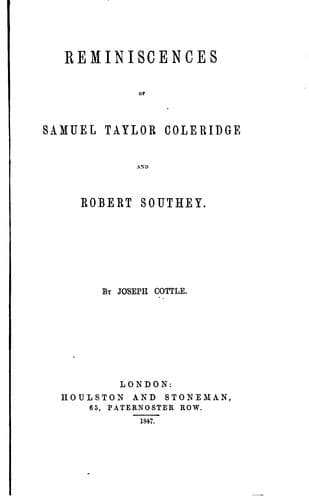
Reminiscences of Samuel Taylor Coleridge and Robert SoutheyCottle, Joseph
General
Reminiscences of Samuel Taylor Coleridge and Robert Southey
Cottle, Joseph
Authors, English -- 19th century -- Biography; Coleridge, Samuel Taylor, 1772-1834; Southey, Robert, 1774-1843
I now proceed with the narrative of Mr. Coleridge's military adventures,
chiefly collected from himself, but not inconsiderably from the
information of other of his more intimate friends; particularly R.
Lovell; although I must apprise the reader that after a lapse of forty
years, I cannot pledge myself for every individual word: a severity of
construction which neither my memoranda nor memory would authorize. In
order not to interrupt the reader, by stating that this was derived from
one source, and that from another, (at this time hardly to be separated
in my own mind) I shall narrate it as though Mr. Coleridge had related
the whole at once, to Mr. Davy and myself.
* * * * *
Mr. Coleridge now told us of one of his Cambridge eccentricities which
highly amused us. He said that he had paid his addresses to a Mary Evans,
who, rejecting his offer, he took it so much in dudgeon, that he withdrew
from the University to London, when, in a reckless state of mind, he
enlisted in the 15th, Elliot's Light Dragoons. No objection having been
taken to his height or age, he was asked his name. He had previously
determined to give one that was thoroughly Kamschatkian, but having
noticed that morning over a door in Lincoln's Inn Fields, (or the Temple)
the name of "Cumberbatch," (not Comberback) he thought this word
sufficiently outlandish, and replied "Silas Tomken Cumberbatch,"[77] and
such was the entry in the regimental book.
Here, in his new capacity, laborious duties devolved on Mr. C. He
endeavoured to think on Caesar, and Epaminondas, and Leonidas, with other
ancient heroes, and composed himself to his fate; remembering, in every
series, there must be a commencement: but still he found confronting him
no imaginary inconveniences. Perhaps he who had most cause for
dissatisfaction, was the drill sergeant, who thought his professional
character endangered; for after using his utmost efforts to bring his raw
recruit into something like training, he expressed the most serious
fears, from his unconquerable awkwardness, that he never should be able
to make _a soldier of him!_
Public-domain text, read in full here on John Shaqi.
Reviews
Reviews
No reviews yet
Be the first to share your thoughts on this work.
Elsewhere in the archive
Join the Discussion
Join the discussion
Sign in to leave a comment or review.
Sign InorCreate an account