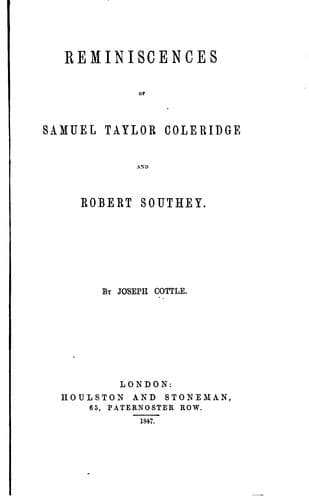
Reminiscences of Samuel Taylor Coleridge and Robert SoutheyCottle, Joseph
General
Reminiscences of Samuel Taylor Coleridge and Robert Southey
Cottle, Joseph
Authors, English -- 19th century -- Biography; Coleridge, Samuel Taylor, 1772-1834; Southey, Robert, 1774-1843
The next day he gave his satire to a friend, to show it to the young man,
who became quite alarmed at the mistake he had made, and also at the
ominous words, "He who wrote this can write more." The cauldron might
boil over with fresh "bubble, bubble, toil and trouble." There was no
time to lose. He therefore immediately proceeded to Mr. C.'s chambers;
apologized for his inconsiderate expressions; thought him to have been
some "rough colt," from the country, again begged his pardon, and
received the hand of reconciliation. This young, miscalculating
Cantabrigian, now became one of Mr. C.'s warmest friends, and rose to
eminence.[75]
The satire was singularly cutting. I can recall but two unconnected
lines:
"With eye that looks around with asking gaze,
And tongue that traffics in the trade of praise."[76]
Mr. Coleridge now told us of the most remarkable of his Cambridge
eccentricities, that of his having enlisted as a soldier. He had
previously stated to me many of the following particulars, yet not the
whole; but (having taken a deep interest in this singular adventure,) in
addition to that which I heard from Mr. C., who never told all the
incidents of his military life to any one person, but on the contrary,
detailed some few to one, and some few to another, I made a point of
collecting from different friends, every scattered fact I could obtain,
and shall now throw the whole into one narrative.
But before I proceed, I must take some notice of a statement on this
subject, communicated to the public, by Mr. Bowles, wherein his account
appears to clash with mine. Of this gentleman (with whose name and
writings I have connected so many pleasant remembrances, from early
life,) I wish to speak with the utmost respect; but the truth Mr. B.
himself will be glad to learn.
Mr. Bowles states a circumstance relating to what he calls, "The most
correct, sublime, chaste, and beautiful of Mr. Coleridge's poems; the
'Religious Musings;'" namely, that "it was written, non inter sylvas
academi, but in the tap-room at Reading." This information could not have
been received from Mr. C. but perhaps was derived from the imperfect
recollection of Captain O.; but whoever the informant may have been, the
assertion has not the merit of being founded on a shadow of accuracy. The
poem of the "Religious Musings" was not written "in the tap-room at
Reading," nor till long after Mr. C. had quitted his military life. It
was written partly at Stowey; partly on Redcliff Hill; and partly in my
parlour, where both Mr. Coleridge and Mr. Southey occasionally wrote
their verses. This will have sufficiently appeared by Mr. C.'s own
letters; to which I could add other decisive evidence, if the subject
were of more consequence.
Public-domain text, read in full here on John Shaqi.
Reviews
Reviews
No reviews yet
Be the first to share your thoughts on this work.
Elsewhere in the archive
Join the Discussion
Join the discussion
Sign in to leave a comment or review.
Sign InorCreate an account