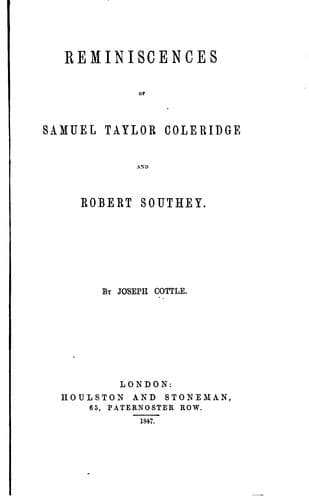
Reminiscences of Samuel Taylor Coleridge and Robert SoutheyCottle, Joseph
General
Reminiscences of Samuel Taylor Coleridge and Robert Southey
Cottle, Joseph
Authors, English -- 19th century -- Biography; Coleridge, Samuel Taylor, 1772-1834; Southey, Robert, 1774-1843
This idea is advanced on the supposition that _one mind_ could command an
unlimited direction over any given number of _limbs_, provided they were
all connected by _joint_ and _sinew_. But suppose, through some occult
and inconceivable means, these limbs were dis-associated, as to all
material connexion; suppose, for instance, one mind with unlimited
authority, governed the operations of _two_ separate persons, would not
this substantially, be only _one person_, seeing the directing principle
was one? If the truth here contended for, be admitted, that _two
persons_, governed by _one mind_, is incontestably _one person_; the same
conclusion would be arrived at, and the proposition equally be justified,
which affirmed that, _three_, or otherwise _four_ persons, owning also
necessary and essential subjection to _one mind_, would only be so many
diversities or modifications of that _one mind_, and therefore, the
component parts virtually collapsing into _one whole_, the person would
be _one_. Let any man ask himself, whose understanding can both reason
and become the depository of truth, whether, if _one mind_ thus regulated
with absolute authority, _three_, or otherwise _four_ persons, with all
their congeries of material parts, would not these parts inert in
themselves, when subjected to one predominant mind, be in the most
logical sense, _one person_? Are ligament and exterior combination
indispensable pre-requisites to the sovereign influence of mind over
mind? or mind over matter?
But perhaps it may be said, we have no instance of one mind governing
more than one body. This may be, but the argument remains the same. With
a proud spirit, that forgets its own contracted range of thought, and
circumscribed knowledge, who is to limit the sway of Omnipotence? or
presumptuously to deny the possibility of _that_ Being, who called light
out of darkness, so to exalt the dominion of _one mind_, as to give it
absolute sway over other dependant minds, or (indifferently) over
detached, or combined portions of organized matter? But if this
superinduced quality be conferable on any order of created beings, it is
blasphemy to limit the power of God, and to deny _his_ capacity to
transfuse _his own_ Spirit, when and to whom he will.
Public-domain text, read in full here on John Shaqi.
Reviews
Reviews
No reviews yet
Be the first to share your thoughts on this work.
Elsewhere in the archive
Join the Discussion
Join the discussion
Sign in to leave a comment or review.
Sign InorCreate an account