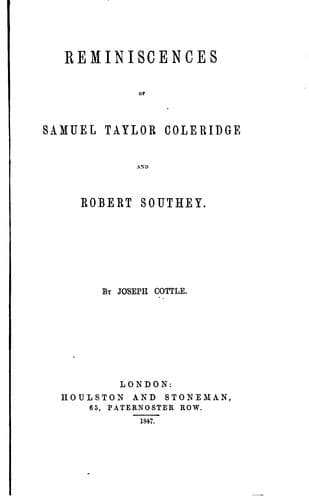
Reminiscences of Samuel Taylor Coleridge and Robert SoutheyCottle, Joseph
General
Reminiscences of Samuel Taylor Coleridge and Robert Southey
Cottle, Joseph
Authors, English -- 19th century -- Biography; Coleridge, Samuel Taylor, 1772-1834; Southey, Robert, 1774-1843
This reasoning may now be applied in illustration of the Trinity. We are
too much in the habit of viewing our Saviour Jesus Christ, through the
medium of his body. 'A body was prepared for him,' but this body was mere
matter; as insensible in itself as every human frame when deserted by the
soul. If therefore the Spirit that was in Christ, was the Spirit of the
Father; if no thought, no vibration, no spiritual communication, or
miraculous display, existed in, or proceeded from Christ, not immediately
and consubstantially identified with Jehovah, the Great First cause; if
all these operating principles were thus derived, in consistency alone
with the conjoint divine attributes; if this Spirit of the Father ruled
and reigned in Christ as his own manifestation, then in the strictest
sense, Christ exhibited 'the Godhead bodily,' and was undeniably '_one_
with the Father;' confirmatory of the Saviour's words: 'Of myself, (my
body) I can do nothing, the Father that dwelleth in me, he doeth the
works.'
But though I speak of the body as inert in itself, and necessarily allied
to matter, yet this declaration must not be understood as militating
against the christian doctrine of the _resurrection of the body_. In its
grosser form, the thought is not to be admitted, for 'flesh and blood
cannot inherit the kingdom of God,' but that the body, without losing its
consciousness and individuality, may be subjected by the illimitable
power of omnipotence, to a sublimating process, so as to be rendered
compatible with spiritual association, is not opposed to reason, in its
severe abstract exercises, while in attestation of this _exhilarating
belief_, there are many remote analogies in nature exemplifying the same
truth, while it is in the strictest accordance with that final
dispensation, which must, as christians, regulate all our speculations. I
proceed now to say, that
If the postulate be thus admitted, that one mind influencing two bodies,
would only involve a diversity of operations, but in reality be one in
essence; or otherwise as an hypothetical argument, illustrative of truth,
if one preeminent mind, or spiritual subsistence, unconnected with
matter, possessed an undivided and sovereign dominion over two or more
disembodied minds, so as to become the exclusive source of all their
subtlest volitions and exercises, the _unity_, however complex the modus
of its manifestation, would be fully established; and this principle
extends to Deity itself, and shows the true sense, as I conceive, in
which Christ and the Father are one.
Public-domain text, read in full here on John Shaqi.
Reviews
Reviews
No reviews yet
Be the first to share your thoughts on this work.
Elsewhere in the archive
Join the Discussion
Join the discussion
Sign in to leave a comment or review.
Sign InorCreate an account