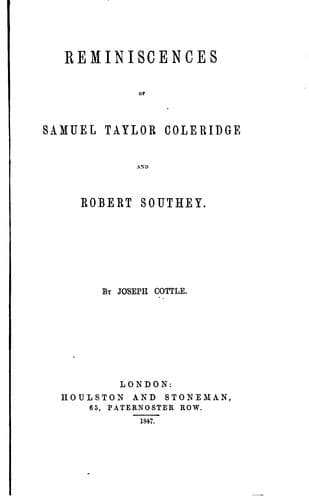
Reminiscences of Samuel Taylor Coleridge and Robert SoutheyCottle, Joseph
General
Reminiscences of Samuel Taylor Coleridge and Robert Southey
Cottle, Joseph
Authors, English -- 19th century -- Biography; Coleridge, Samuel Taylor, 1772-1834; Southey, Robert, 1774-1843
In continuation of this reasoning, if God who is light, the Sun of the
moral world, should in his union of infinite wisdom, power, and goodness,
and from all eternity, have ordained that an emanation from himself,--for
aught we know, an essential emanation, as light is inseparable from the
luminary of day--should not only have existed in his Son, in the fulness
of time to be united to a mortal body, but that a like emanation from
himself, also perhaps essential, should have constituted the Holy Spirit,
who, without losing his ubiquity, was more especially sent to this lower
earth, _by_ the Son, _at_ the impulse of the Father, then in the most
comprehensive sense, God, and his Son Jesus Christ, and the Holy Ghost,
are ONE. 'Three persons in one God,' and thus form the true Trinity in
Unity.
To suppose that more than one independent power, or governing mind,
exists in the whole universe, is absolute Polytheism, against which the
denunciations of all the Jewish and Christian canonical books were
directed. And if there be but ONE directing MIND, that mind is God!
operating however, in three persons, according to the direct and uniform
declarations of that inspiration which 'brought life and immortality to
light.' Yet this divine doctrine of the Trinity is to be received, not
because it is or can be clear to finite apprehension, but, in reiteration
of the argument, because the Scriptures, in their unsophisticated
interpretation expressly state it. The Trinity, therefore, from its
important aspects, and biblical prominence, is the grand article of
faith, and the foundation of the whole christian system.
Who can say, as Christ and the Holy Ghost proceeded from, and are still
one with the Father, and as all the disciples of Christ derive their
fulness from him, and, in spirit, are inviolately united to him as a
branch is to the vine, who can say, but that in one view, what was once
mysteriously separated, may as mysteriously, be re-combined, and, without
interfering with the everlasting Trinity, and the individuality of the
spiritual and seraphic orders, the Son at the consummation of all things,
deliver up his mediatorial kingdom to the Father, and God, in some
peculiar and infinitely sublime sense, become all in all! God love you,
S. T. Coleridge."[83]
Public-domain text, read in full here on John Shaqi.
Reviews
Reviews
No reviews yet
Be the first to share your thoughts on this work.
Elsewhere in the archive
Join the Discussion
Join the discussion
Sign in to leave a comment or review.
Sign InorCreate an account