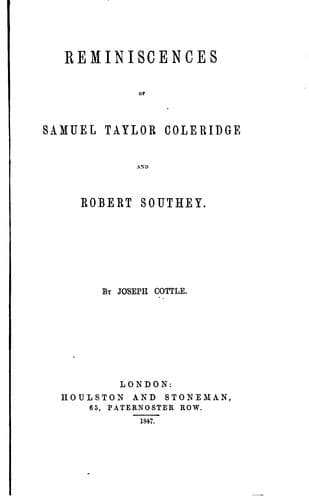
Reminiscences of Samuel Taylor Coleridge and Robert SoutheyCottle, Joseph
General
Reminiscences of Samuel Taylor Coleridge and Robert Southey
Cottle, Joseph
Authors, English -- 19th century -- Biography; Coleridge, Samuel Taylor, 1772-1834; Southey, Robert, 1774-1843
The whole company looked at Mr. Holcroft, implying that _now_ was the
time for him to meet a competent opponent, and justify sentiments which
he had so often triumphantly advanced. They looked in vain. He
maintained, to their surprise, a total silence, well remembering the
severe castigation he had so recently received. But a very different
effect was produced on Mrs. Holcroft. She indignantly heard, and giving
vent to her passion and her _tears_, said, she was quite surprised at Mr.
Coleridge talking in that way before her, when he knew that both herself
and Mr. Holcroft were atheists!
Mr. C. spoke of the unutterable horror he felt, when Holcroft's son, a
boy eight years of age, came up to him and said, "There is no God!" So
that these wretched parents, alike father and mother, were as earnest in
inculcating atheism on their children, as christian parents are in
inspiring their offspring with respect for religious truth.
Actions are often the best illustration of principles. Mr. Coleridge also
stated the following circumstance, notorious at the time, as an evidence
of the disastrous effects of atheism. Holcroft's tyrannical conduct
toward his children was proverbial. An elder son, with a mind embued with
his father's sentiments, from extreme severity of treatment, had run away
from his paternal roof, and entered on board a ship. Holcroft pursued his
son, and when the fugitive youth saw his father in a boat, rowing toward
the vessel, rather than endure his frown and his chastisement, he seized
a pistol, and blew his brains out![85]
An easy transition having been made to the Bible, Mr. C. spoke of our
Saviour with an utterance so sublime and reverential, that none could
have heard him without experiencing an accession of love, gratitude, and
adorations to the Great Author of our salvation. He referred to the
Divinity of Christ, as a truth, incontestable to all who admitted the
inspiration, and consequent authority of Scripture. He particularly
alluded to the 6th of John, v. 15. "When Jesus perceived that they would
come and take him by force to make him a king, he departed again into a
mountain '_alone_.'" He said it characterized the low views, and
worldly-mindedness of the Jews, that, after they had seen the miracles of
Jesus Christ, and heard his heavenly doctrine, and had been told that his
kingdom was not of this world, they should think of conferring additional
honour on him, by making him their King! He departed from these little
views and scenes, _by night_, to a neighbouring mountain, and there, in
the spirit of _prescience_, meditated on his approaching crucifixion; on
that attendant guilt, which would bring on the Jews, wrath to the
uttermost, and terminate their impieties, by one million of their race
being swept from the face of the earth.
Public-domain text, read in full here on John Shaqi.
Reviews
Reviews
No reviews yet
Be the first to share your thoughts on this work.
Elsewhere in the archive
Join the Discussion
Join the discussion
Sign in to leave a comment or review.
Sign InorCreate an account