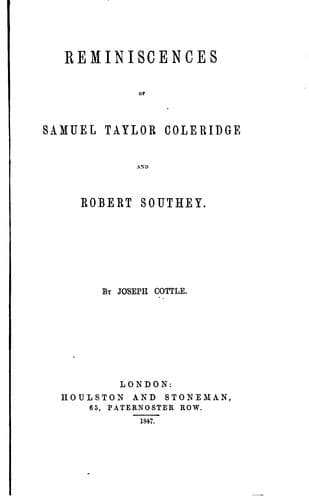
Reminiscences of Samuel Taylor Coleridge and Robert SoutheyCottle, Joseph
General
Reminiscences of Samuel Taylor Coleridge and Robert Southey
Cottle, Joseph
Authors, English -- 19th century -- Biography; Coleridge, Samuel Taylor, 1772-1834; Southey, Robert, 1774-1843
Mr. C. noticed Doddridge's works with great respect, particularly his
"Rise and Progress of Religion."[86] He thought favourably of Lord
Rochester's conversion as narrated by Burnet; spoke of Jeremy Taylor in
exalted terms, and thought the compass of his mind discovered itself in
none of his works more than in his "Life of Christ," extremely
miscellaneous as it was. He also expressed the strongest commendation of
Archbishop Leighton, whose talents were of the loftiest description, and
which were, at the same time, eminently combined with humility. He
thought Bishop Burnet's high character of Leighton justly deserved, and
that his whole conduct and spirit were more conformed to his Divine
Master, than almost any man on record.
I now proceed to say, it was with extreme reluctance that the Unitarians
in Bristol resigned their champion, especially as other defections had
recently occurred in their community, and that among the more
intellectual portion of their friends. Although the expectation might be
extravagant, they still cherished the hope, however languid, that Mr. C.
after some oscillations, would once more bestow on them his suffrage; but
an occurrence took place, which dissipated the last vestige of this hope,
and formed between them a permanent wall of separation.
Mr. Coleridge was lecturing in Bristol, surrounded by a numerous
audience, when, in referring to the "Paradise Regained," he said that
Milton had clearly represented Satan, as a "sceptical Socinian." This was
regarded as a direct and undisguised declaration of war. It so happened
that indisposition prevented me from attending that lecture, but I
received from Mr. C. directly after, a letter, in which he thus writes:
"... Mr. ---- I find is raising the city against me, as far as he and his
friends can, for having stated a mere matter of fact; viz. that Milton
had represented Satan as a sceptical Socinian; which is the case; and I
could not have explained the excellence of the sublimest single passage
in all his writings, had I not previously informed the audience, that
Milton had represented Satan, as knowing the Prophetic and Messianic
character of Christ, but was sceptical as to any higher claims. And what
other definition could Mr. ---- himself give of a sceptical Socinian?
(with this difference indeed, that Satan's faith somewhat exceeded that
of Socinians.) Now that Satan has done so, will you consult 'Paradise
Regained,' Book IV. from line 196, and the same Book, from line 500."
It is of consequence that Mr. Coleridge's _later_ sentiments on the
subject of Socinianism should be given; but as I had no opportunity of
ascertaining what those sentiments were, it was satisfactory to learn
from the testimony of Mr. C.'s "Table Talk,"[87] that his last and
maturest opinions were, to the fullest, confirmatory of those expressed
by him in these pages.
Public-domain text, read in full here on John Shaqi.
Reviews
Reviews
No reviews yet
Be the first to share your thoughts on this work.
Elsewhere in the archive
Join the Discussion
Join the discussion
Sign in to leave a comment or review.
Sign InorCreate an account