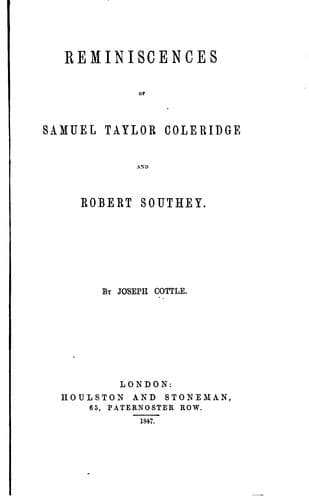
Reminiscences of Samuel Taylor Coleridge and Robert SoutheyCottle, Joseph
General
Reminiscences of Samuel Taylor Coleridge and Robert Southey
Cottle, Joseph
Authors, English -- 19th century -- Biography; Coleridge, Samuel Taylor, 1772-1834; Southey, Robert, 1774-1843
The following letter was written by Mr. Coleridge, to Mr. George Fricker,
his brother-in-law; it is believed in 1807. Mr. F. died 1828; pious and
respected.
"Saturday afternoon.
My dear young friend,
I am sorry that you should have felt any delicacy in disclosing to me
your religious feelings, as rendering it inconsistent with your
tranquillity of mind to spend the Sunday evening with me. Though I do not
find in that book, which we both equally revere, any command, either
express, or which I can infer, which leads me to attach any criminality
to cheerful and innocent social intercourse on the Lord's day; though I
do not find that it was in the least degree forbidden to the Jews on
their Sabbath; and though I have been taught by Luther, and the great
founders of the Church of England, that the Sabbath was a part of the
ceremonial and transitory parts of the law given by heaven to Moses; and
that our Sunday is binding on our consciences, chiefly from its manifest
and most awful usefulness, and indeed moral necessity; yet I highly
commend your firmness in what you think right, and assure you solemnly,
that I esteem you greatly for it. I would much rather that you should
have too much, than an atom too little. I am far from surprised that,
having seen what you have seen, and suffered what you have suffered, you
should have opened your soul to a sense of our fallen nature; and the
incapability of man to heal himself. My opinions may not be in all points
the same as yours; but I have experienced a similar alteration. I was for
many years a Socinian; and at times almost a Naturalist, but sorrow, and
ill health, and disappointment in the only deep wish I had ever
cherished, forced me to look into myself; I read the New Testament again,
and I became fully convinced, that Socinianism was not only not the
doctrine of the New Testament, but that it scarcely deserved the name of
a religion in any sense. An extract from a letter which I wrote a few
months ago to a sceptical friend, who had been a Socinian, and of course
rested all the evidences of christianity on miracles, to the exclusion of
grace and inward faith, will perhaps, surprise you, as showing you how
much nearer our opinions are than what you must have supposed. 'I fear
that the mode of defending christianity, adopted by Grotius first; and
latterly, among many others, by Dr. Paley, has increased the number of
infidels;--never could it have been so great, if thinking men had been
habitually led to look into their own souls, instead of always looking
out, both of themselves, and of their nature. If to curb attack, such as
yours on miracles, it had been answered:--"Well, brother! but granting
these miracles to have been in part the growth of delusion at the time,
and of exaggeration afterward, yet still all the doctrines will remain
untouched by this circumstance, and binding on thee. Still mast thou
repent and be regenerated, and be crucified to the flesh; and this not by
Public-domain text, read in full here on John Shaqi.
Reviews
Reviews
No reviews yet
Be the first to share your thoughts on this work.
Elsewhere in the archive
Join the Discussion
Join the discussion
Sign in to leave a comment or review.
Sign InorCreate an account