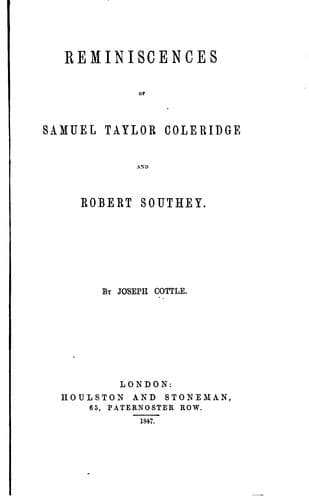
Reminiscences of Samuel Taylor Coleridge and Robert SoutheyCottle, Joseph
General
Reminiscences of Samuel Taylor Coleridge and Robert Southey
Cottle, Joseph
Authors, English -- 19th century -- Biography; Coleridge, Samuel Taylor, 1772-1834; Southey, Robert, 1774-1843
My dear Sir,--I sympathize with you on the comparatively recent loss of
so large a proportion of your early friends and acquaintance. I can, to a
great extent, participate in similar feelings. Yourself and Mr.
Wordsworth are the only two survivors, of all with whom in early life I
joined in familiar intercourse, for poor dear Southey since I last wrote
to you concerning him, is worse than dead. Mr. W., who dined with me last
summer, told me that he does not now know his own children. He said, he
had a short time previously called upon him, and he fancied that a slight
glimpse of remembrance crossed his mind, when, in a moment, he silently
passed to his library, and taking down a book, (from mechanical habit)
turned over the pages, without reading, or the power of reading. Pardon
prolixity, where the heart is so full. Surely the world does not present
a more melancholy, or a more humiliating sight, than the prostration of
so noble a mind as that of my old and highly-prized friend, Robert
Southey. When I first knew him, he had all that Westminster and Oxford
could give him. He was, as the Mores said, to whom I had introduced him,
'brimfull of literature:' decisive and enthusiastic in all his
sentiments, and impetuous in all his feelings, whether of approval or
dislike. I never knew one more uncompromising in what he believed either
to be right, or wrong; thereby marking the integrity of his mind, which
ever shrunk from the most distant approximation to duplicity or meanness.
This disposition manifested itself almost in infancy, for his mother, an
acute and very worthy woman, told me, in the year 1798, that whenever any
mischief or accident occurred amongst the children, which some might wish
to conceal, she always applied to Robert, who never hesitated, or
deviated from the truth, though he himself might have been implicated.
And in after life, whatever sentiments he avowed, none who knew the
confirmed fidelity of his mind, could possibly doubt that they were the
genuine dictates of his heart.
There was in Southey, alas! his sun is set!--I must, write in the third
person!--one other quality which commands admiration; an habitual
delicacy in his conversation, evidencing that cheerfulness and wit might
exist without ribaldry, grossness, or profanation. He neither violated
decorum himself, nor tolerated it in others. I have been present when a
trespasser of the looser class, has received, a rebuke, I might say a
castigation, well deserved, and not readily forgotten. His abhorrence
also of injustice, or unworthy conduct, in its diversified shapes, had
all the decision of a Roman censor; while this apparent austerity was
associated, when in the society he liked, with so bland and playful a
spirit, that it abolished all constraint, and rendered him one of the
most agreeable, as well as the most intelligent of companions.
Public-domain text, read in full here on John Shaqi.
Reviews
Reviews
No reviews yet
Be the first to share your thoughts on this work.
Elsewhere in the archive
Join the Discussion
Join the discussion
Sign in to leave a comment or review.
Sign InorCreate an account