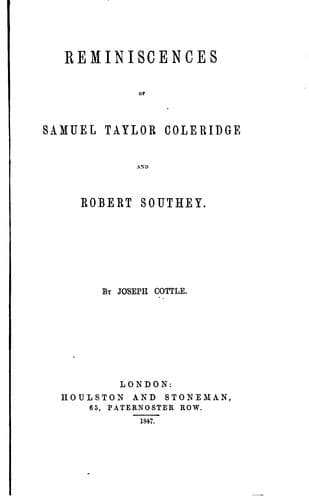
Reminiscences of Samuel Taylor Coleridge and Robert SoutheyCottle, Joseph
General
Reminiscences of Samuel Taylor Coleridge and Robert Southey
Cottle, Joseph
Authors, English -- 19th century -- Biography; Coleridge, Samuel Taylor, 1772-1834; Southey, Robert, 1774-1843
It must occasionally have been exemplified in your experience, that some
writers who have acquired a transient popularity, perchance, more from
adventitious causes, than sterling merit, appear at once to occupy an
increased space, and fancy that he who fills his own field of vision,
occupies the same space in the view of others. This disposition will
almost invariably be found in those who most readily depreciate those
whom they cannot excel; as if every concession to the merits of another
subtracted from their own claims. Southey was eminently exempt from this
little feeling. He heartily encouraged genius, wherever it was
discoverable; whether, 'with all appliances,' the jewel shone forth from
academic bowers, or whether the gem was incrusted with extraneous matter,
and required the toil of polishing; indifferent to him, it met with the
encouraging smile, and the fostering care.
It may be truly said, Mr. Southey exacted nothing, and consequently his
excellencies were the more readily allowed; and this merit was the
greater, since, as Mr. Coleridge remarked, "he had written on so many
subjects, and so well on all." Although his company was sought by men of
the first rank and talent, from whom he always received that
acknowledgment, if not deference, which is due to great attainments and
indisputable genius, yet such honours excited no plebeian pride. It
produced none of that morbid inflation, which, wherever found,
instinctively excites a repulsive feeling. It was this unassuming air,
this suavity of deportment, which so attached Southey to his friends, and
gave such permanence to their regard.
It seems almost invidious to single out one distinguishing quality in his
mind, when so many deserve notice, but I have often been struck with the
quickness of his perception; the promptitude with which he discovered
whatever was good or bad in composition, either in prose or verse. When
reading the production of another, the tones of his voice became a
_merit-thermometer_, a sort of _Aeolian-harp-test_; in the flat parts his
voice was unimpassioned, but if the gust of genius swept over the wires,
his tones rose in intensity, till his own energy of feeling and
expression kindled in others a sympathetic impulse, which the dull were
forced to feel, whilst his animated recitations threw fresh meaning into
the minds of the more discerning.
Public-domain text, read in full here on John Shaqi.
Reviews
Reviews
No reviews yet
Be the first to share your thoughts on this work.
Elsewhere in the archive
Join the Discussion
Join the discussion
Sign in to leave a comment or review.
Sign InorCreate an account