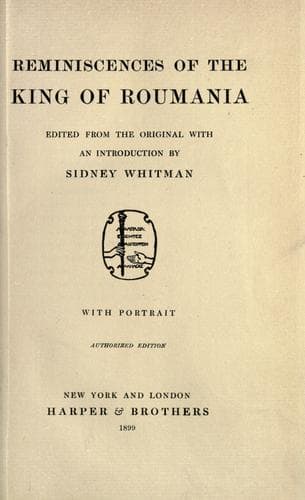
Reminiscences of the King of RoumaniaKremnitz, Mite
History
Reminiscences of the King of Roumania
Kremnitz, Mite
Carol I, King of Romania, 1839-1914; Eastern question (Balkan); Jews -- Romania; Romania -- History -- Charles I, 1866-1914
"It is more than probable that both sides will soon become exhausted
in a localised war; the only question is, which of the two will give
in first. Russia's eyes will always be fixed on her own interests,
never on those of Roumania; and, since there is no such thing as
gratitude in politics, I recommend you to exercise the utmost
caution.
"Europe will not interest itself in a defeated and fallen
Roumania--it will only have regard for a free country which is
not tied down by treaties. Prudence and moderation are therefore
necessary at so critical a period, which will either prove to be a
wholesome era of transition for your country, or will bear the seeds
of its annihilation."
The efforts of the Russian diplomats in Constantinople now appeared
to be confined to delaying the advance of the Russian army until
a more favourable season of the year should have arrived. Prince
Charles Anthony thus sketched the possible results of the coming war
in a letter to his son dated March 1, 1877:
"Russia will hardly gain great triumphs--a few military
successes may be achieved, but certainly none of any political
importance. The army and the Slav element must content
themselves with a small modicum of glory, whilst the Czar
Alexander may think himself lucky in returning to peaceful and
normal circumstances, and in having mastered a movement which
is of the greatest danger to Russia. The only tangible result
of the whole Russian initiative will, perhaps, be that the
suzerainty of the Porte over Roumania is transferred to Russia.
"Roumania would thereby be supported by a stronger and more
stable Power, with, perhaps, more freedom at home and abroad,
but would certainly not achieve her longed-for recognition as an
independent and equal State.
"The forms of the suzerainty would perhaps be more equable and
more pleasant, but the dependence, though tolerable, would
always be felt.
"This would merely be an exchange of _rôles_. Europe would then
admire Russia's moderation, and would doubtless concede every
demand made along the lines I have suggested. The sacrifice of
Roumania would thus be a message of peace, on which would hinge
the return to the universal _entente_."
A final attempt to settle the Eastern Question by means of the
London Protocol met with as little success as the efforts of the
Conference; and the Russo-Roumanian Convention was signed on April
16, 1877, by Baron Stuart on behalf of the Czar, and M. Cogalniceanu
on behalf of Prince Charles. The following were the chief articles
of the Convention:
(1) The Russian army to be granted a free passage through Roumania,
the Russian Government paying all expenses connected therewith.
(2) The Government of the Czar pledges itself to maintain and
protect the actual integrity and political rights of Roumania.
Public-domain text, read in full here on John Shaqi.
Reviews
Reviews
No reviews yet
Be the first to share your thoughts on this work.
Elsewhere in the archive
Join the Discussion
Join the discussion
Sign in to leave a comment or review.
Sign InorCreate an account