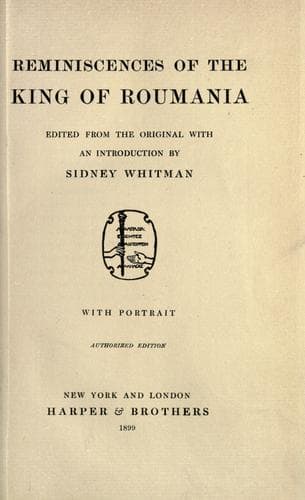
Reminiscences of the King of RoumaniaKremnitz, Mite
History
Reminiscences of the King of Roumania
Kremnitz, Mite
Carol I, King of Romania, 1839-1914; Eastern question (Balkan); Jews -- Romania; Romania -- History -- Charles I, 1866-1914
"I have followed the successes of your brave troops with
undiminished attention. Their organisation has justified
itself, the spirit of the officers is the result of your
training. Their achievements have everywhere been such as one
could hardly expect from veteran troops. This attainment of an
object persistently pursued must be the highest reward for your
self-sacrificing efforts, and is at the same time a triumph over
the public opinion of Europe, which has never had much sympathy
with the Roumanian State and its army.
"At the present it is impossible to foresee what will happen
after the fall of Plevna. I do not believe in the prophecies
of the Press regarding an expected peace, for Russia cannot
possibly content herself with the result of Plevna. She must
set right the mistaken beginning of the whole campaign against
Turkey, which rested upon false calculations and disparagement
of the enemy. These events, however, have been fortunate for
Roumania, for the insufficiency of the Russian means of war was
the very reason why the support of the Roumanian army became
a necessity. It seems almost the work of Providence that such
tasks and efforts in the theatre of war should have fallen to
the lot of the Roumanians as to place them on a footing of
equality in the eyes of Russia and Europe....
"As soon as the military difficulties have been conquered,
political troubles will accumulate to a still greater degree.
The Triple Alliance must now prove its strength, for, if it is
firmly united, the decision of European affairs will lie in its
hands alone...."
Princess Elisabeth awaited her husband, from whom she had been
separated for four long and anxious months, at Titu, from whence
they reached Bucharest at one o'clock. The whole population of the
capital turned out to do honour to their ruler, who had shared their
dangers and their troubles, and who had achieved the independence of
his adopted country sword in hand.
The day closed with a magnificent torchlight procession under the
windows of the palace, after which Prince Charles and his wife drove
through the brilliantly illuminated streets.
Whilst Prince Charles had been manfully engaged in the field, the
Princess had made it her special care to look after "her" wounded,
as she termed them, and it was therefore with a special pleasure
that the Prince learnt that the merciful efforts of his wife had
been recognised and appreciated by the Czarina, who sent a special
messenger to Princess Elisabeth with the Order of St. Catherine in
brilliants, on the occasion of her birthday (December 29).
Public-domain text, read in full here on John Shaqi.
Reviews
Reviews
No reviews yet
Be the first to share your thoughts on this work.
Elsewhere in the archive
Join the Discussion
Join the discussion
Sign in to leave a comment or review.
Sign InorCreate an account