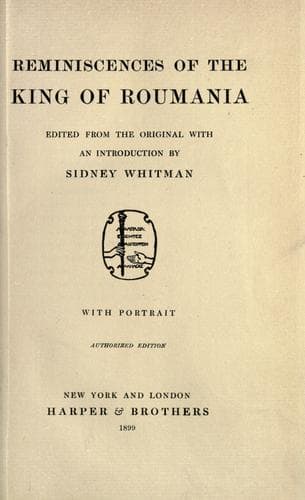
Reminiscences of the King of RoumaniaKremnitz, Mite
History
Reminiscences of the King of Roumania
Kremnitz, Mite
Carol I, King of Romania, 1839-1914; Eastern question (Balkan); Jews -- Romania; Romania -- History -- Charles I, 1866-1914
Prince Bismarck, speaking of the Eastern Question in the Reichstag,
said the preliminaries of peace in no way affected the interests
of Germany, and that there was no cause to exchange the part of a
spectator for that of an actor. The question of the Dardanelles
alone was of great importance, for "the water ways, the straits,
as well as the Danube from the Black Sea northwards, must remain
open to German commerce." Germany, declared the Chancellor, would
not adopt the attitude of an arbitrator, but that of an "honest
broker," who had every intention of doing business (_i.e._, in
effecting a lasting peace). The German Empire would never sacrifice
the friendship with Russia, which had been proved through past
generations, in order to obtain the vain credit of playing the judge
in Europe!
The attitude to be adopted by Prince Charles was thus sketched out
by his father:
"The offered portion of the unproductive Dobrutscha is, indeed,
no compensation for the cession of Bessarabia, but will,
nevertheless, be acceptable if Küstendje forms part of the
bargain. Indeed, the acquisition of this Black Sea port may
perhaps be of the greatest importance to the future of the
flourishing commerce of Roumania. The _conditio sine quâ non_
for the incorporation of the district on the right bank must be
the dismantling of the Danubian fortresses, for an autonomous
Bulgaria has no need for fortified protection on its northern
frontier, whilst they might, even under changed circumstances,
prove a danger to Roumania, as they would become so many
sally-ports in time of war."
The virgin fortress of Widin, which had been invested by three
Roumanian Divisions, was handed over by Isset Pacha on February 24,
when the Turkish garrison marched out with all the honours of war.
An enormous quantity of munitions of war was found in the magazines,
but the supplies of food appeared to be almost exhausted. A day
later the rock fortress of Belgradjik was also handed over to the
Roumanians with the same ceremonies.
The following laconic telegram from the Grand Duke Nicholas was
handed to Prince Charles on March 3, 1878:
"It is with great pleasure that I inform you that the peace has
just been signed."
CHAPTER XI
THE BERLIN CONGRESS AND AFTER
Public-domain text, read in full here on John Shaqi.
Reviews
Reviews
No reviews yet
Be the first to share your thoughts on this work.
Elsewhere in the archive
Join the Discussion
Join the discussion
Sign in to leave a comment or review.
Sign InorCreate an account