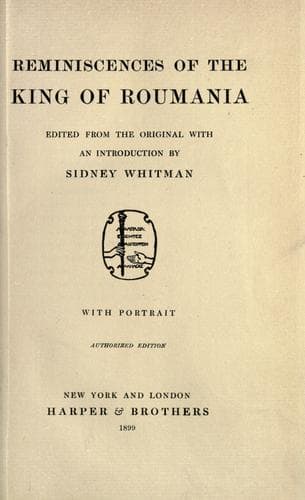
Reminiscences of the King of RoumaniaKremnitz, Mite
History
Reminiscences of the King of Roumania
Kremnitz, Mite
Carol I, King of Romania, 1839-1914; Eastern question (Balkan); Jews -- Romania; Romania -- History -- Charles I, 1866-1914
The feelings of consternation and bitter resentment evoked by the
publication of the Treaty of San Stefano soon found expression in
the Roumanian Chamber, where the action of the Russian Government
was criticised in scathing terms, and in the Press, whose comments
on the situation were little calculated to restrain the popular
indignation. The Minister of the Exterior telegraphed to the various
Roumanian diplomatic agents abroad that the Government felt itself
compelled to protest against a treaty, every article of which was
either directly or indirectly opposed to the interests of Roumania.
Prince Charles, on the other hand, was convinced of the futility of
all protests, and the impossibility of retaining Bessarabia, and was
therefore chiefly concerned in checking the growing hostility of the
Roumanian nation towards their all-powerful neighbour. At the same
time no effort was spared to secure the representation of Roumania
at the impending European Congress, and M. Bratianu, the President
of the Ministry, was despatched for this purpose to Vienna and
Berlin with letters from the Prince himself.
Though the general disposition towards Roumania on the part of
the Great Powers was that of lukewarm platonic sympathy, a ray of
hope was at one time afforded by the warlike attitude of England,
who would only agree to a Congress empowered to consider the whole
of the Treaty of San Stefano. General Ignatieff traversed Europe
in order to effect an understanding between the several Cabinets.
Prince Charles Anthony, however, warned his son that "the loss of
the Bessarabian region must now be regarded as inevitable, and the
only consolation is that the sympathy of public opinion generally is
accorded to you and to your country."
During the absence of Bratianu, Prince Gortchakoff transmitted to
the Roumanian Agent in St. Petersburg a threat which had fallen from
the mouth of the Czar himself: that if Roumania protested against
Article VIII. of the Treaty (which defined the route of the Russian
troops through Roumania), he, the Czar, would disarm the Roumanian
army. Prince Charles at once caused the following reply to be
forwarded: "The Roumanian army, which fought so gallantly before
Plevna under the eyes of the Czar, may be annihilated, but will
never be disarmed!"
Public-domain text, read in full here on John Shaqi.
Reviews
Reviews
No reviews yet
Be the first to share your thoughts on this work.
Elsewhere in the archive
Join the Discussion
Join the discussion
Sign in to leave a comment or review.
Sign InorCreate an account