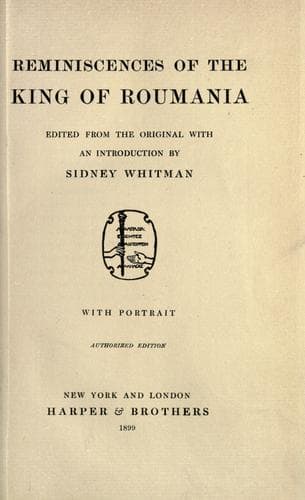
Reminiscences of the King of RoumaniaKremnitz, Mite
History
Reminiscences of the King of Roumania
Kremnitz, Mite
Carol I, King of Romania, 1839-1914; Eastern question (Balkan); Jews -- Romania; Romania -- History -- Charles I, 1866-1914
The chief task of the new Government was to secure the recognition
of their new ruler by the Powers, but the telegrams from the
Roumanian agents abroad showed very plainly that the _fait accompli_
was only the first step towards the desired end. The initiative
of the Prince found favour, it is true, with Napoleon, but his
Minister, Drouyn de L'Huys, regarded his action as an insult to the
Paris Conference, whilst the Sultan refused to receive the letter
addressed to him by Prince Charles, and announced his intention of
applying to the Conference for sanction to occupy the Principalities
by armed force. To meet this possibility, the immediate mobilisation
of the Roumanian Army was decided upon by the Cabinet, and the
Prince seized an occasion for reviewing the troops on May 24. The
Turkish protest against the election was submitted to the Conference
on the following day, but the Powers decided that Turkey was
not entitled to occupy Roumanian territory without the previous
consent of the Powers, and also declared that they had broken off
official communications with the Prince's Government. As the news
from Constantinople became more and more threatening, a credit
of eight million francs was voted by the Roumanian Chamber for
warlike purposes, and orders were issued for the concentration of
the frontier battalions and Dorobanz Cavalry. The former, however,
mutinied and refused to leave their garrisons, whilst an inspection
of the arsenal showed that there was scarcely enough powder in the
magazines for more than a few rounds to each soldier.
The deputation sent to conciliate Russia met with a cold reception
from Prince Gortchakoff, who complained that France had been
consulted before the _fait accompli_. He further remonstrated
against the collection of Polish refugees on the Roumanian frontier.
On the other hand, he did not appear averse from an alliance between
Prince Charles and the Russian Imperial family. Bismarck received
the members of the deputation with cordiality, and recommended them
to assume an anti-Austrian attitude in the event of an insurrection
in Hungary. In the meantime, the Paris Conference declined to
appoint commissaries for the Principalities, as had been done
formerly under the Hospodars, and practically decided to leave
Roumania an open question.
The finances of the Principalities were completely disorganised, as
the Public Treasury was empty, the floating debt amounted to close
on seven millions sterling, and it seemed as though the year 1866
would indicate a deficit of another six millions. To complete the
financial ruin of the country, a proposal to create paper money was
set on foot, but was thrown out by the Chamber.
Public-domain text, read in full here on John Shaqi.
Reviews
Reviews
No reviews yet
Be the first to share your thoughts on this work.
Join the Discussion
Join the discussion
Sign in to leave a comment or review.
Sign InorCreate an account