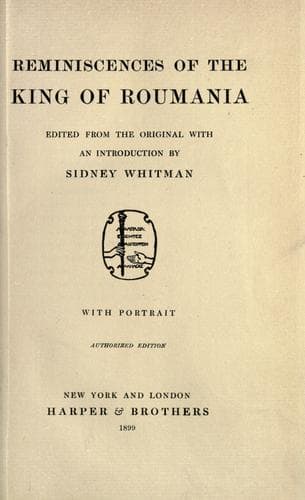
Reminiscences of the King of Roumania — John Shaqi
Reminiscences of the King of RoumaniaKremnitz, Mite
History
Reminiscences of the King of Roumania
Kremnitz, Mite
Carol I, King of Romania, 1839-1914; Eastern question (Balkan); Jews -- Romania; Romania -- History -- Charles I, 1866-1914
"In accepting the throne of Roumania, I knew that the duties
devolving on me were enormous: still I confess that the
difficulties to be surmounted are even greater than I thought.
"The most complete disorder in the finances as well as in all
the branches of the Administration gives rise to difficulties
against which I have to struggle every day, and which render my
task extremely painful....
"A greater power than that of man--the Divine--sends us fresh
trials. The whole country, especially Moldavia, is threatened
with a famine.... The only means of succouring the populace
is by means of a loan.... Trusting, Sire, in the affectionate
sentiments of your Majesty, I ask you for the aid of your
all-powerful goodwill, because it is the knowledge of your
Majesty's constant goodwill to the Roumanians and, I venture to
say, to me personally, that has sustained me in the midst of the
difficulties with which I have had to contend...."
The Prince concluded with the words: "The happiness of the
Roumanian nation has become the aim of my life: I have devoted
to this mission all my time and all my aspirations."
Owing to the active support of France, the Sublime Porte declared
its willingness to concede certain points of the Roumanian
counter-project, such as the election of the Prince, the hereditary
succession in the Prince's family, and the establishment of the Army
at 30,000 men, but demanded in return the recognition of Roumania as
a _partie intégrale_ of the Ottoman Empire.
On August 21, Prince Charles set out on a journey through
Moldavia, accompanied by General Prince Ghika, Mavrogheni, and his
aides-de-camp. The route ran through Buseu, Fokschani, which was
devastated by cholera, and Ajud, where the long awaited rain first
fell on the dried-up country, then through Kaitz to Okna, where
the Prince inspected the great salt mines and the prison. The next
important halts were made at Botoschani, an almost wholly Jewish
town, and at the Moldavian capital, Jassy, romantically situated
on the banks of the Bachlui. The town is built in terraces on the
hillside, where the numerous domes and towers scattered amongst
the green trees lend it a most picturesque and almost oriental
appearance. The reception accorded to the Prince was brilliant and
hearty in the extreme, the only discordant note being the refusal
of the Rosnovanu family to share in the public rejoicings. It is,
however, pleasant to note that in later years this family sought to
show by every means how completely their opinions had changed.
Public-domain text, read in full here on John Shaqi.
Reviews
Reviews
No reviews yet
Be the first to share your thoughts on this work.
Join the Discussion
Join the discussion
Sign in to leave a comment or review.
Sign InorCreate an account