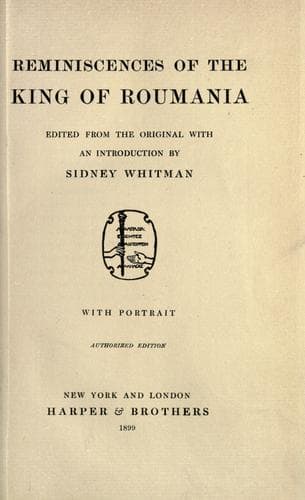
Reminiscences of the King of RoumaniaKremnitz, Mite
History
Reminiscences of the King of Roumania
Kremnitz, Mite
Carol I, King of Romania, 1839-1914; Eastern question (Balkan); Jews -- Romania; Romania -- History -- Charles I, 1866-1914
The second visit to the Sultan took place on October 28, and was
marked by the same heartiness as before. Prince Charles, on leaving
the Palace, _en route_ for a review specially ordered in his honour,
passed through the Marble Gates, which are generally opened for the
Sultan alone. The review took place in pouring rain on the heights
of Pancaldi, where six battalions, two cavalry regiments, and four
batteries were drawn up. Ali Pacha entertained the Prince at dinner
the same evening, when Prince Charles proposed the health of the
Sultan, and expressed the wishes he shared in common "with all
Roumanians" for the welfare of the Sultan and of the Turkish Empire.
In reply the Grand Vizier laid special stress upon the deep interest
his Imperial Majesty took in the Prince and "the Moldo-Wallachian
population." Ali Pacha subsequently offered the Prince a number
of Turkish orders of the various classes, adding that the patents
would be sent to him in blank every year, and might be granted as
the Prince thought fit. This offer was, however, declined, and
the permission of the Porte was obtained for the institution of a
medal for the Roumanian Army. After taking leave of the Sultan on
October 30, Prince Charles returned to Varna in the Imperial yacht
_Issedin_, arriving in Bucharest on November 2.
The impending elections now claimed the attention of Prince Charles,
who, in a letter to the President of the Ministry, declared that
"not even the shadow of influence" must be brought to bear on the
electors. The Government, however, misconstrued the expression of
this wish as a concession to the Liberal Opposition. The result of
the elections was a bitter disappointment to the Prince and his
advisers: one-third of the new Chamber was composed of partisans of
the ex-Prince Kusa and Separatists, a second of supporters of the
Government, and the third of Liberals. Not one of these parties,
therefore, could dispose of a decisive majority. The Chamber was
opened on November 27 by Prince Charles in person, who adjured the
Deputies to lay aside all jealousies and personal interests, and to
aid him in reorganising the country by "accepting the wholesome
principles of honesty, industry, and economy, which alone can raise
the civilisation, wealth, and power of the nation."
The failure of the crops in conjunction with famine and cholera had
added to the already heavy financial difficulties of the country.
The paper currency was at 30 per cent. discount, whilst the pay of
the Army and the officials remained in arrears. In spite of the
applause with which the Prince's speech was received, the Government
measures were obstructed at every turn by incessant intrigues in the
Chamber.
The following most interesting letter from the Prince's father,
bearing on the difficulties of Napoleon's position, was received on
December 24, 1866:
"The position of France is at present most insecure. Napoleon's
dynasty must struggle with four immense difficulties:
Public-domain text, read in full here on John Shaqi.
Reviews
Reviews
No reviews yet
Be the first to share your thoughts on this work.
Join the Discussion
Join the discussion
Sign in to leave a comment or review.
Sign InorCreate an account