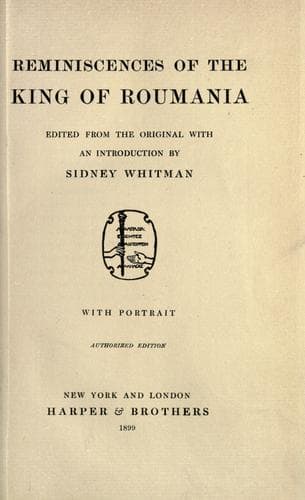
Reminiscences of the King of RoumaniaKremnitz, Mite
History
Reminiscences of the King of Roumania
Kremnitz, Mite
Carol I, King of Romania, 1839-1914; Eastern question (Balkan); Jews -- Romania; Romania -- History -- Charles I, 1866-1914
"The Prince is very popular, much loved and highly esteemed
personally, but his Government (that of Ghika) is unpopular,
wanting in initiative, foresight, and firmness, so that its
position is not solid. Reforms make no progress, Russian
intrigues have ample play, because the indecision of the
Government and its want of energy throw doubt on its stability.
Only to-day a diplomat remarked to me that the Russian party is
getting the upper hand, that Russophile officers, such as a
certain Solomon and others, have regained their influence and
position, and that those who helped to elect the Prince are
discouraged at seeing Russia, the eternal enemy of the country,
in the ascendant."
After alluding to the project of a Russian marriage, the letter
continued:
"The Prince will soon be convinced that Russian ambition will
not give way to sentiment or family ties. It marches straight
to its goal in spite of opposition, and yields to nothing but
superior force."
Another letter from the same quarter addressed to the Prince
gives the following quaint definition of the faults of the German
character:
"The German is never sympathetic to foreign nations, he is
deficient in charm, in grace. The North German is too stiff; the
South German is too heavy ever to awaken feelings of sympathy.
This is as true as that the earth turns on its axis. Even
admitting that in diplomacy one may be ungrateful, nevertheless
the punishment seldom fails, as witness Austria, which has paid
heavily for its ingratitude. It is most imprudent to alienate
yourself from France."
An application for permission to return to Roumania was received on
May 26, from the exiled Prince Kusa, who alleged that his presence
was required in a lawsuit affecting his private interests. Though
Prince Charles was inclined to grant this favour, the decision was
left to his Ministry, who opposed the project, as they had reason to
believe that Prince Kusa's presence might provoke troubles.
An unsuccessful attempt to assassinate the Czar was made on June 7,
1867, when the Prince wrote to congratulate his Imperial Majesty on
his escape. The Czar replied as follows:
Public-domain text, read in full here on John Shaqi.
Reviews
Reviews
No reviews yet
Be the first to share your thoughts on this work.
Join the Discussion
Join the discussion
Sign in to leave a comment or review.
Sign InorCreate an account