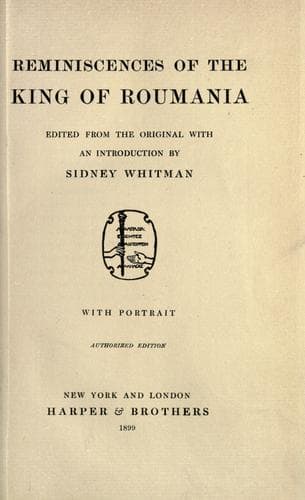
Reminiscences of the King of RoumaniaKremnitz, Mite
History
Reminiscences of the King of Roumania
Kremnitz, Mite
Carol I, King of Romania, 1839-1914; Eastern question (Balkan); Jews -- Romania; Romania -- History -- Charles I, 1866-1914
Crémieux, the well-known politician and founder of the _Alliance
Israélite_, interviewed the Prince on June 14, 1866, to try to
obtain an alteration in the laws enabling Jews to hold land in
Roumania, and, acting on the time-honoured maxim of _do ut des_,
offered in return for this privilege a loan of £1,000,000 at a low
rate of interest. The Prince informed him that the Government had
already remembered the condition of the Jews in the draft of the
Constitution, since the following paragraphs had been inserted:
"Creed is no impediment to naturalisation in Roumania," and "So
far as the Jews at present domiciled in Roumania are concerned, a
special law will provide for their gradual admission as naturalised
citizens." However, as soon as these proposals were laid before
the Chamber, a wave of dissent swept over Moldavia, where the
anti-dynastic party sought to create trouble by appealing to racial
hatred. They succeeded only too well, for a riotous mob destroyed
the recently completed synagogue at Bucharest in June 1866. The
obnoxious paragraphs of the Constitution were withdrawn owing to
the representations of the Jews themselves, who feared further
excesses, if the Government persisted in them. The foreign Press
eagerly seized the opportunity for spreading the report that, owing
to the weakness of the Government, the paragraphs had been withdrawn
in obedience to the wishes of the mob. The liberally minded Prince,
to show his displeasure at the action of a section of the populace,
and at the same time to prove his toleration in matters of religion,
subscribed 6,000 ducats from his own purse for the restoration of
the wrecked synagogue, but at the same time the Chamber, by passing
the clause: "Only Christians can become Roumanian citizens," denied
the Jews the possession of any political rights.
In April 1867 the Minister of the Interior, J. Bratianu, addressed
a circular to all prefects, ordering them to proceed against all
"vagabonds" in their districts; as, owing to the abolition of
passes, the number of paupers had increased to such an extent as to
add seriously to the already enormous difficulties of the Government
in feeding the starving inhabitants. England, France, and Austria
protested vigorously against this measure, which was chiefly
directed against immigrant Jews, and the Emperor Napoleon addressed
the following telegram to the Prince on this subject:
"I must not leave your Highness in ignorance of the public
feeling created here by the persecutions of which the Jews of
Moldavia are said to be the victims. I cannot believe that the
enlightened Government of your Highness authorises measures so
opposed to humanity and civilisation.
"NAPOLEON."
To which the Prince replied at once:
Public-domain text, read in full here on John Shaqi.
Reviews
Reviews
No reviews yet
Be the first to share your thoughts on this work.
Elsewhere in the archive
Join the Discussion
Join the discussion
Sign in to leave a comment or review.
Sign InorCreate an account