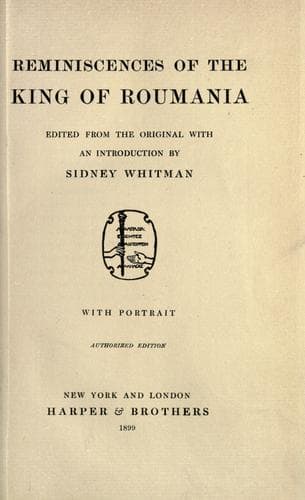
Reminiscences of the King of RoumaniaKremnitz, Mite
History
Reminiscences of the King of Roumania
Kremnitz, Mite
Carol I, King of Romania, 1839-1914; Eastern question (Balkan); Jews -- Romania; Romania -- History -- Charles I, 1866-1914
"Your Majesty may rest assured that I am not less solicitous for
the Jewish inhabitants than your Majesty. The measures which the
Government has thought necessary to take are not exceptional,
and are a matter of common law. I shall, moreover, institute a
severe inquiry to ascertain whether the subaltern officials have
exceeded their instructions. Those guilty will be punished with
all the rigour of the law.
"CHARLES."
All the laws against the Jews which had been passed in Moldavia
since 1804 were published in the official _Moniteur_ on May 28,
1867, to counteract the prejudice which the recent circular had
created. It was thus made clear that Jews had always been prohibited
from becoming tenants of farms, public-houses, and drinking-booths;
and that the sole motive of the Ministerial Circular was to remind
the prefects of the existence of these regulations, which had been
allowed to fall somewhat into abeyance.
Sir Moses Montefiore, the well-known British merchant and
philanthropist, who was touring through Roumania to investigate
personally the condition of the Jews, was presented to the Prince by
the British Consul on August 25, 1867. Sir Moses was able to inform
his Highness that he could not trace any persecution of the Jews in
Wallachia, and on his return to England declared, through the Press,
that the situation of his brethren in Roumania had been painted
in colours far too dark, and that there could be no question of
their ill-treatment, as both the Prince and his Ministers were very
tolerant, and had given him every assistance in eliciting the truth.
The Chamber, however, continued to persist in anti-Semitic
legislation, and a "free and independent party" of thirty-three
Moldavians introduced a measure on March 17, 1868, which contained
the following provisions: "Jews may only settle in urban districts
by permission of the town council, but on no condition, and for no
length of time, in the rural districts.
"They are not allowed to possess real property in towns or in the
country. Sales and purchases in their favour are null and void.
"They are also forbidden to become tenants of farms, vineyards,
public-houses, hotels, kilns, bridges, &c., or to manage the same,
and neither the State nor Communalities are to entrust them with
contracts.... They are not to sell food or liquor to Christians, but
only to Jews." Bratianu, whom the foreign Semitic Press hounded down
as a persecutor of the Jews, opposed this motion with the greatest
vigour, and openly broke with its proposers. He was in consequence
overwhelmed with contumely and reproaches, and was on one occasion
stoned by anti-Semitic mobs in Moldavia.
The Jewish Question was ably summed up by Prince Charles Anthony in
a letter to his son, received on May 21, 1868.
Public-domain text, read in full here on John Shaqi.
Reviews
Reviews
No reviews yet
Be the first to share your thoughts on this work.
Elsewhere in the archive
Join the Discussion
Join the discussion
Sign in to leave a comment or review.
Sign InorCreate an account