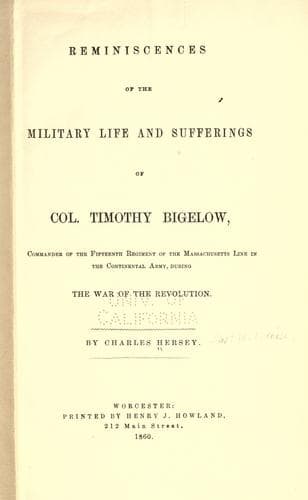
Reminiscences of the Military Life and Sufferings of Col. Timothy Bigelow, Commander of the Fifteenth Regiment of the Massachusetts Line in the Continental Army, during the War of the Revolution — John Shaqi
Reminiscences of the Military Life and Sufferings of Col. Timothy Bigelow, Commander of the Fifteenth Regiment of the Massachusetts Line in the Continental Army, during the War of the RevolutionHersey, Charles
History
Reminiscences of the Military Life and Sufferings of Col. Timothy Bigelow, Commander of the Fifteenth Regiment of the Massachusetts Line in the Continental Army, during the War of the Revolution
Hersey, Charles
Bigelow, Timothy, 1739-1790; United States -- History -- Revolution, 1775-1783; United States. Continental Army -- Military life
Gen. Gates takes the command of the southern army. The British at this
time had almost undisputed possession of South Carolina, Georgia and
North Carolina. In this condition Gates resolved to risk a general
battle with Lord Cornwallis, and for which he was severely blamed. He
lost the battle, hence the blame. If, on the other hand, he had gained
it, he would have gained another laurel to place by the side of the one
gained at Saratoga. At this battle, Gen. Gates lost more than two
thousand men, and among them three valuable officers. Gen. Gregory was
killed, and Baron de Kalb and Gen. Rutherford of Carolina were taken
prisoners. This was the result of the battle at Camden. At this time,
Col. Bigelow was watching the movements of the British troops in New
York, Connecticut and Rhode Island. In this stage of the narrative, the
writer cannot refrain from a passing tribute of respect to the memory of
those patriotic women of South Carolina, who displayed so ardent, so
rare a love of country, that scarcely could there be found in ancient or
modern history an instance more worthy to excite surprise and
admiration. They repaired on board ships, they descended into dungeons
where their husbands, children or friends were in confinement. They
carried them consolation and encouragement. "Summon your magnanimity,"
they said, "yield not to the fury of tyrants; hesitate not to prefer
prisons to infamy, death to servitude. America has fixed her eyes on her
beloved defenders; you will reap, doubt it not, the fruit of your
sufferings; they will produce liberty, that parent of all blessing; they
will shelter her forever from the assaults of British banditti; you are
the martyrs of a cause the most grateful to Heaven, and sacred to man."
By such words these generous women mitigated the miseries of the unhappy
prisoners. Exasperated at their constancy, the English condemned the
most zealous of them to banishment and confiscation. In bidding a last
farewell to their fathers, their children, their brothers, their
husbands, these heroines, far from betraying the least mark of
weakness, which in men might have been excused, exhorted them to arm
themselves with intrepidity. They conjured them not to allow fortune to
vanquish them, nor to suffer the love they bore their families to render
them unmindful of all they owed their country. A supernatural alacrity
seemed to animate them, when they accompanied their husbands into
distant countries, and even when they immured themselves with them in
the fetid ships into which they were inhumanly crowded. Reduced to the
most frightful indigence, they were seen to beg bread for themselves and
families. Among those who were nurtured in the lap of opulence, many
passed suddenly from the most delicate and the most elegant style of
living, to the rudest toils, and to the humblest services. But
humiliation could not triumph over their resolution and cheerfulness;
their example was a support to their companions in misfortune. To this
Public-domain text, read in full here on John Shaqi.
Reviews
Reviews
No reviews yet
Be the first to share your thoughts on this work.
Join the Discussion
Join the discussion
Sign in to leave a comment or review.
Sign InorCreate an account