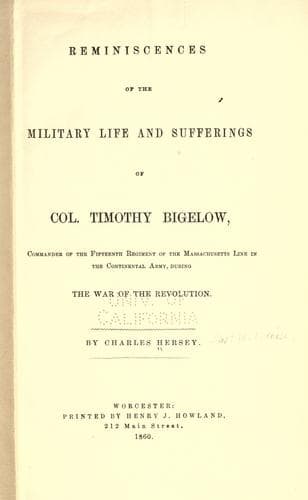
Reminiscences of the Military Life and Sufferings of Col. Timothy Bigelow, Commander of the Fifteenth Regiment of the Massachusetts Line in the Continental Army, during the War of the Revolution — John Shaqi
Reminiscences of the Military Life and Sufferings of Col. Timothy Bigelow, Commander of the Fifteenth Regiment of the Massachusetts Line in the Continental Army, during the War of the RevolutionHersey, Charles
History
Reminiscences of the Military Life and Sufferings of Col. Timothy Bigelow, Commander of the Fifteenth Regiment of the Massachusetts Line in the Continental Army, during the War of the Revolution
Hersey, Charles
Bigelow, Timothy, 1739-1790; United States -- History -- Revolution, 1775-1783; United States. Continental Army -- Military life
Now comes the celebrated 19th day of October, 1781. The day began to
appear, the allies open a tremendous fire from all their batteries; the
bombs showered copiously, the French fleet, under the command of Count
De Grasse, are opening a most deadly fire from the harbor. Lord
Cornwallis sends in a flag to General Washington, proposing a cessation
of arms for twenty-four hours. Washington would not consent to it, and
would grant but two hours, and during this interval he should expect the
propositions of the British commander. The proposition is made and
accepted. The British flotilla, consisting of two frigates, the
Guadaloupe and Fowey, besides about twenty transports (twenty others had
been burnt during the siege), one hundred and sixty pieces of field
artillery, mostly brass, with eight mortars, more than seven thousand
prisoners, exclusive of seamen, five hundred and fifty slain, including
one officer (Major Cochrane), were surrendered into the hands of the
armies of France and America, whose loss was about four hundred and
fifty in killed and wounded.
At the news of so glorious, so important a victory, transports of
exultation broke out from one extremity of America to the other. Nobody
dared longer to doubt of independence. A poet in Col. Bigelow's
regiment, made a short song commemorative of this event, in which
occurred these lines,
"Count DeGrasse he lies in the harbor,
And Washington is on shore."
A wag in Worcester, after they had returned, changed it so as to make it
read thus:
"Count DeGrasse he lies in the harbor,
And Bigelow is on shore."
Such was the end of the campaign of Virginia, which was well nigh being
that of the American war. This laid the foundation of a general peace.
Thus ended a long and arduous conflict, in which Great Britain expended
an hundred million of money, with an hundred thousand lives, and won
nothing. The United States endured great cruelty and distress from their
enemies, lost many lives and much treasure, but finally delivered
themselves from a foreign dominion, and gained a rank among the nations
of the earth.
XII.
CLOSE OF THE REVOLUTION.
After the surrender of Yorktown, the American army divide. Part of the
troops return to the banks of the Hudson, to watch the motions of
Clinton, who had still a large force at New York. The rest were sent to
South Carolina, to reinforce General Green, and confirm the authority of
Congress in those provinces.
Col. Bigelow and his regiment were among those that returned to the
Hudson. The Marquis de la Fayette embarked about the same time for
Europe, bearing with him the affection of the whole American people. In
a few months, Gen. Green had driven the British from the southern
colonies, and they retire to New York, to join the main army.
Col. Bigelow is ordered to leave West Point, where he was stationed, and
proceed to Rhode Island.
Public-domain text, read in full here on John Shaqi.
Reviews
Reviews
No reviews yet
Be the first to share your thoughts on this work.
Join the Discussion
Join the discussion
Sign in to leave a comment or review.
Sign InorCreate an account