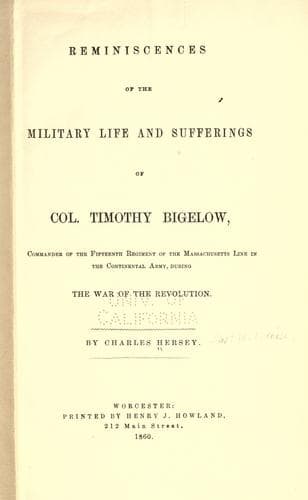
Reminiscences of the Military Life and Sufferings of Col. Timothy Bigelow, Commander of the Fifteenth Regiment of the Massachusetts Line in the Continental Army, during the War of the Revolution — John Shaqi
Reminiscences of the Military Life and Sufferings of Col. Timothy Bigelow, Commander of the Fifteenth Regiment of the Massachusetts Line in the Continental Army, during the War of the RevolutionHersey, Charles
History
Reminiscences of the Military Life and Sufferings of Col. Timothy Bigelow, Commander of the Fifteenth Regiment of the Massachusetts Line in the Continental Army, during the War of the Revolution
Hersey, Charles
Bigelow, Timothy, 1739-1790; United States -- History -- Revolution, 1775-1783; United States. Continental Army -- Military life
The writer of the following pages was dandled upon the knee of a worthy
sire, who had spent eight years of his life in the struggle for
Independence, and taught me the name of Col. Bigelow, long before I was
able to articulate his name. Many have been the times, while sitting on
my father's lap around the old hearthstone, now more than fifty years
since, that I listened to affecting reminiscences of Col. Bigelow and
others, until his voice would falter, and tears would flow down his aged
and careworn face, and then my mother and elder members of the family
would laugh, and inquire, "what is there in all of that, that should
make you weep?" but I always rejoiced with him, and wept when I saw him
weep. After the death of my father, having engaged in the active scenes
of life, those childish memories in some degree wore away, but the
happiest moments of my life have been spent in company with some old
Revolutionary Patriot, while I listened to the recital of their
sufferings and their final conquest. The first history of the American
Revolution I ever read, is found in Morse's Geography, published in
1814. This I read until I had committed the whole to memory. The next
was what may be found in Lincoln's History of Worcester, published in
1836, and from which I have taken liberal extracts. The next is the
History of the War of Independence of the United States of America,
written by Charles Botta, translated from the Italian by George
Alexander Otis, in 1821; from this also, I have taken extracts. I have
also consulted Lossing's Pictorial Field Book of the Revolution. In
neither of these histories (except Lincoln's) does the name of Col.
Bigelow occur. Therefore I have depended principally upon tradition,
coming from his own brethren in arms, and corroborated by history. It
has been exceedingly difficult to trace the course and conduct of Col.
Bigelow from any history of the war; but history, aided by tradition,
makes up the history of any man. To illustrate: I get the account of
Col. Bigelow's conduct at the battle of Monmouth, as stated in section
vii, from Mr. Solomon Parsons, which I received from his own lips more
than forty years ago, and saw in his journal; and more than thirty years
since, I heard Gen. Lafayette and Mr. Parsons refer to those scenes,[A]
the remembrance of which drew tears from each of their eyes, and also
from many of the spectators. I find that Mr. Parsons was in Lafayette's
detachment, Gen. Green's division, Gen. Glover's brigade, and Col.
Bigelow's regiment. All of this I knew forty years ago, from tradition.
From history we all know that Gen. Lafayette and Gen. Green were at that
battle, and I am happy to say this whole subject has very recently
become an item of history, which may be found on page 260 of Washburn's
History of Leicester. In this way, and from such sources, I have
gathered the facts embodied in these pages. As to the personal
appearance of Col. Bigelow, I have procured from witnesses who were as
Public-domain text, read in full here on John Shaqi.
Reviews
Reviews
No reviews yet
Be the first to share your thoughts on this work.
Join the Discussion
Join the discussion
Sign in to leave a comment or review.
Sign InorCreate an account