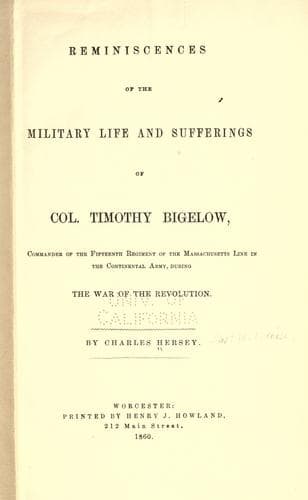
Reminiscences of the Military Life and Sufferings of Col. Timothy Bigelow, Commander of the Fifteenth Regiment of the Massachusetts Line in the Continental Army, during the War of the RevolutionHersey, Charles
History
Reminiscences of the Military Life and Sufferings of Col. Timothy Bigelow, Commander of the Fifteenth Regiment of the Massachusetts Line in the Continental Army, during the War of the Revolution
Hersey, Charles
Bigelow, Timothy, 1739-1790; United States -- History -- Revolution, 1775-1783; United States. Continental Army -- Military life
The name of Timothy Bigelow stands conspicuous in the history of
Worcester. As early as 1773, we find him on a committee with Wm. Young,
David Bancroft, Samuel Curtis, and Stephen Salisbury, to report upon the
grievances under which the province labored, and also upon what was then
called the "Boston Pamphlet," which had been introduced at the town
meeting in March. The writer of this article thinks that this "Boston
Pamphlet" was John Hancock's oration in commemoration of the "Bloody
Massacre" of the 5th of March, 1770. At the adjourned meeting, in May
following, this committee made an elaborate report, recommending a
committee of correspondence. The town adopted the report, and elected as
the committee, Wm. Young, Timothy Bigelow, and John Smith. In December
following, the leading whigs of the town assembled and formed a society,
which afterwards took the name of the American Political Society, and
Nathan Baldwin, Samuel Curtis, and Timothy Bigelow, were chosen a
committee to report a constitution. This society, with Timothy Bigelow
for a leader, did good service to the town and to the country. Their
last and most powerful blow was struck in town meeting, 7th of March,
1774, when the society presented a long preamble and resolutions, which
were considered by the royalists to be treasonable and revolutionary.
"When these resolutions were read," said an eye-witness of the scene to
the writer, "fear, anxiety and awful suspense, sat upon the countenance
of every man of the whig party except Timothy Bigelow, the blacksmith;
while the tories were pale with rage." After a few moments, James
Putnam, the leader of the tories, arose. Putnam was said to be "the best
lawyer in North America. His arguments were marked by strong and clear
reasoning, logical precision and arrangement, and that sound judgment
whose conclusions were presented so forcibly as to command assent." He
made such a speech against the resolutions as had never before been
heard in Worcester; and when he sat down, the same informant said that
"not a man of the whig party thought a single word could be said,--that
old Putnam, the tory, had wiped them all out." Timothy Bigelow at length
arose, without learning, without practice in public speaking, without
wealth,--the tories of Worcester had, at that day, most of the wealth
and learning,--but there he stood upon the floor of the Old South
Church, met the Goliath of the day, and vanquished him. The governor of
Massachusetts Bay, and the crown and parliament of Great Britain, were
brought to feel the effect of his sling and stone. Suffice it to say,
the resolutions were carried triumphantly. This was the first grand
public effort made by Col. Timothy Bigelow, in his part of the great
drama of the American revolution.
III.
THE MINUTE MEN.
Public-domain text, read in full here on John Shaqi.
Reviews
Reviews
No reviews yet
Be the first to share your thoughts on this work.
Join the Discussion
Join the discussion
Sign in to leave a comment or review.
Sign InorCreate an account