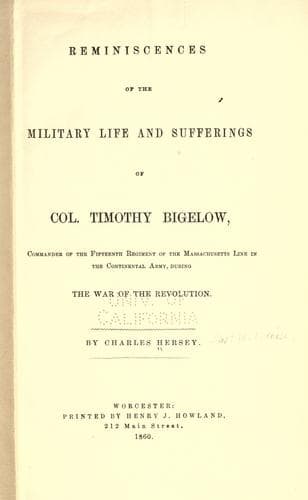
Reminiscences of the Military Life and Sufferings of Col. Timothy Bigelow, Commander of the Fifteenth Regiment of the Massachusetts Line in the Continental Army, during the War of the RevolutionHersey, Charles
History
Reminiscences of the Military Life and Sufferings of Col. Timothy Bigelow, Commander of the Fifteenth Regiment of the Massachusetts Line in the Continental Army, during the War of the Revolution
Hersey, Charles
Bigelow, Timothy, 1739-1790; United States -- History -- Revolution, 1775-1783; United States. Continental Army -- Military life
We left Col. Bigelow with the American army, under the command of Gen.
Gates, on the banks of the Hudson, exulting over the capture of Burgoyne
and the flower of the British army. The next we hear of him, he, with
his regiment, together with Col. Morgan's celebrated rifle corps and one
or two other regiments, are ordered to march to the relief of the army
in Pennsylvania, under the command of Gen. Washington. This campaign in
Pennsylvania was very disastrous to the American army. Being poorly
clothed, and more poorly fed, they were not in condition to meet the
tried veterans of the English army. It was said of this reinforcement
from Gen. Gates' army, that they were men of approved courage, and
flushed with recent victory, but squalid in their appearance, from
fatigue and want of necessaries. But when Col. Bigelow led his regiment
into line with the main army at White Marsh, a small place about
fourteen miles from Philadelphia, he was recognized by the
commander-in-chief, as the very identical Capt. Bigelow whom he had seen
at Cambridge with a company of minute men from Worcester; and while
Washington held Col. Bigelow by the hand to introduce him to his brother
officers, he said, "This, gentlemen officers, is Col. Bigelow, and the
15th regiment of the Massachusetts line under his command. This,
gentlemen, is the man who vanquished the former royalists in his own
native town. He marched the first company of minute men from Worcester
at the alarm from Lexington. He shared largely in the sufferings of the
campaign against Quebec, and was taken prisoner there. After his
exchange he raised a regiment in his own neighborhood, and joining the
northern army under Gen. Gates, participated in the struggle with
Burgoyne, and shares largely in the honor of that victory."
It was said by an eye-witness, that "this was an exceedingly interesting
and affecting event, and could not fail to satisfy every one of the high
estimation in which the commander-in-chief held Col. Bigelow."
The American army was now watching the movements of Sir William Howe,
commander of the British army, who soon landed his troops at the head of
Elk river, in two columns, the right commanded by Gen. Knyphausen, the
left by Lord Cornwallis. After several skirmishes, the two armies met
upon the banks of the Brandywine. In this battle, the Americans were
unsuccessful, and soon after the British army took possession of
Philadelphia, and the American army took their position at Germantown,
which is six miles northwest from Philadelphia. Here again the Americans
are repulsed, and each army retires to winter quarters, the British to
Philadelphia, the American to Valley Forge.
VI.
AT VALLEY FORGE.
Public-domain text, read in full here on John Shaqi.
Reviews
Reviews
No reviews yet
Be the first to share your thoughts on this work.
Join the Discussion
Join the discussion
Sign in to leave a comment or review.
Sign InorCreate an account