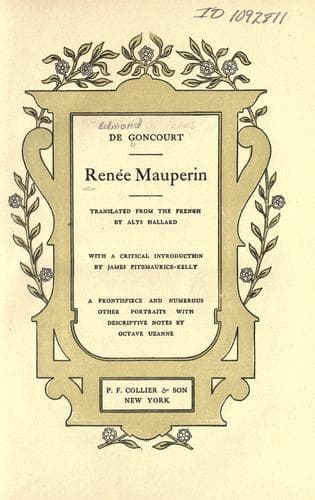
France -- Social life and customs -- 19th century -- Fiction
Every day M. Mauperin sought for something in his daughter which he
could not find--something which was no longer there. Her eyes, her
smile, her gestures, her footstep, her very dress which used proudly to
tell of her twenty years, the girlish vivacity which seemed to hover
round her and light on others as it passed--everything about her was
changing and life itself gradually leaving her. She no longer seemed to
animate all that she touched. Her clothes fell loosely round her in
folds as they do on old people. Her step dragged along, and the sound of
her little heels was no longer heard. When she put her arms round her
father's neck, she joined her hands awkwardly, her caresses had lost
their pretty gracefulness. All her gestures were stiff, she moved about
like a person who feels cold or who is afraid of taking up too much
space. Her arms, which were generally hanging down, now looked like the
wet wings of a bird. She scarcely even resembled her old self. And when
she was walking in front of her father, with her bent back, her shrunken
figure, her arms hanging loosely at her sides, and her dress almost
falling off her, it seemed to M. Mauperin that this could not be his
daughter, and as he looked at her he thought of the Renee of former
days.
There was a shadow round her mouth that seemed to go inside when she
smiled. The beauty spot on her hand, just by her little finger, had
grown larger, and was as black as though mortification had set in.
LI
"Mother, it's Henri's birthday to-day."
"Yes, I know," said Mme. Mauperin without moving.
"Suppose we were to go to church?"
Mme. Mauperin rose and went out of the room, returning very soon with
her bonnet and cape on. Half an hour later M. Mauperin was helping his
daughter out of the carriage at the Maricourt church-door. Renee went to
the little side-chapel, where the marble altar stood on which was the
little miraculous black wooden Virgin to which she had prayed with great
awe as a child. She sat down on a bench which was always there and
murmured a prayer. Her mother stood near her, looking at the church and
not praying at all. Renee then got up and, without taking her father's
arm, walked with a step that scarcely faltered right through the church
to a little side door leading into the cemetery.
"I wanted to see whether _that_ was still there," she said to her
father, pointing to an old bouquet of artificial flowers among the
crosses and wreaths which were hung on the tomb.
"Come, my child," said M. Mauperin; "don't stand too long. Let us go
home again now."
"Oh, there's plenty of time."
There was a stone seat under the porch with a ray of sunshine falling on
it.
"It's warm here," she said, laying her hand on the stone. "Put my shawl
there so that I can sit down a little. I shall have the sun on my
back--there."
"It isn't wise," said M. Mauperin.
Public-domain text, read in full here on John Shaqi.
Reviews
Reviews
No reviews yet
Be the first to share your thoughts on this work.
Elsewhere in the archive
Join the Discussion
Join the discussion
Sign in to leave a comment or review.
Sign InorCreate an account