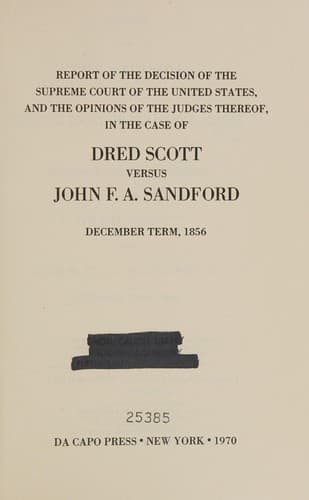
Report of the Decision of the Supreme Court of the United States, and the Opinions of the Judges Thereof, in the Case of Dred Scott versus John F. A. Sandford: December Term, 1856.United States. Supreme Court
History
Report of the Decision of the Supreme Court of the United States, and the Opinions of the Judges Thereof, in the Case of Dred Scott versus John F. A. Sandford: December Term, 1856.
United States. Supreme Court
Scott, Dred, 1809-1858; Slavery -- United States
A large class of cases has been decided upon the second of the
propositions above stated, in the Southern and Western courts--cases
in which the law of the actual domicil was adjudged to have altered
the native condition and _status_ of the slave, although he had never
actually possessed the _status_ of freedom in that domicil. (Rankin
_v._ Lydia, 2 A.K.M.; Herny [Transcriber's Note: Harry] _v._ Decker,
Walk., 36; 4 Mart., 385; 1 Misso., 472; Hunter _v._ Fulcher, 1 Leigh
[Transcriber's Note: full citation as given elsewhere is 1 Leigh,
172].)
I do not impugn the authority of these cases. No evidence is found in
the record to establish the existence of a domicil acquired by the
master and slave, either in Illinois or Minnesota. The master is
described as an officer of the army, who was transferred from one
station to another, along the Western frontier, in the line of his
duty, and who, after performing the usual tours of service, returned
to Missouri; these slaves returned to Missouri with him, and had been
there for near fifteen years, in that condition, when this suit was
instituted. But absence, in the performance of military duty, without
more, is a fact of no importance in determining a question of a change
of domicil. Questions of that kind depend upon acts and intentions,
and are ascertained from motives, pursuits, the condition of the
family, and fortune of the party, and no change will be inferred,
unless evidence shows that one domicil was abandoned, and there was an
intention to acquire another. (11 L. and Eq., 6; 6 Exch., 217; 6 M.
and W., 511; 2 Curt. Ecc. R., 368.)
The cases first cited deny the authority of a foreign law to dissolve
relations which have been legally contracted in the State where the
parties are, and have their actual domicil--relations which were never
questioned during their absence from that State--relations which are
consistent with the native capacity and condition of the respective
parties, and with the policy of the State where they reside; but which
relations were inconsistent with the policy or laws of the State or
Territory within which they had been for a time, and from which they
had returned, with these relations undisturbed. It is upon the
assumption, that the law of Illinois or Minnesota was indelibly
impressed upon the slave, and its consequences carried into Missouri,
that the claim of the plaintiff depends. The importance of the case
entitles the doctrine on which it rests to a careful examination.
Public-domain text, read in full here on John Shaqi.
Reviews
Reviews
No reviews yet
Be the first to share your thoughts on this work.
Elsewhere in the archive
Join the Discussion
Join the discussion
Sign in to leave a comment or review.
Sign InorCreate an account