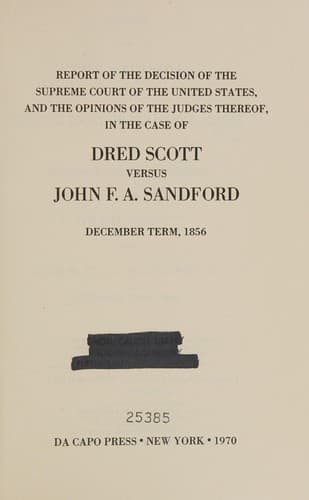
Report of the Decision of the Supreme Court of the United States, and the Opinions of the Judges Thereof, in the Case of Dred Scott versus John F. A. Sandford: December Term, 1856.United States. Supreme Court
History
Report of the Decision of the Supreme Court of the United States, and the Opinions of the Judges Thereof, in the Case of Dred Scott versus John F. A. Sandford: December Term, 1856.
United States. Supreme Court
Scott, Dred, 1809-1858; Slavery -- United States
It will be conceded, that in countries where no law or regulation
prevails, opposed to the existence and consequences of slavery,
persons who are born in that condition in a foreign State would not be
liberated by the accident of their introgression. The relation of
domestic slavery is recognised in the law of nations, and the
interference of the authorities of one State with the rights of a
master belonging to another, without a valid cause, is a violation of
that law. (Wheat. Law of Na., 724; 5 Stats. at Large, 601; Calh. Sp.,
378; Reports of the Com. U.S. and G.B., 187, 238, 241.)
The public law of Europe formerly permitted a master to reclaim his
bondsman, within a limited period, wherever he could find him, and one
of the capitularies of Charlemagne abolishes the rule of prescription.
He directs, "that wheresoever, within the bounds of Italy, either the
runaway slave of the king, or of the church, or of any other man,
shall be found by his master, he shall be restored without any bar or
prescription of years; yet upon the provision that the master be a
Frank or German, or of any other nation (foreign;) but if he be a
Lombard or a Roman, he shall acquire or receive his slaves by that law
which has been established from ancient times among them." Without
referring for precedents abroad, or to the colonial history, for
similar instances, the history of the Confederation and Union affords
evidence to attest the existence of this ancient law. In 1783,
Congress directed General Washington to continue his remonstrances to
the commander of the British forces respecting the permitting negroes
belonging to the citizens of these States to leave New York, and to
insist upon the discontinuance of that measure. In 1788, the resident
minister of the United States at Madrid was instructed to obtain from
the Spanish Crown orders to its Governors in Louisiana and Florida,
"to permit and facilitate the apprehension of fugitive slaves from the
States, promising that the States would observe the like conduct
respecting fugitives from Spanish subjects." The committee that made
the report of this resolution consisted of Hamilton, Madison, and
Sedgwick, (2 Hamilton's Works, 473;) and the clause in the Federal
Constitution providing for the restoration of fugitive slaves is a
recognition of this ancient right, and of the principle that a change
of place does not effect a change of condition. The diminution of the
power of a master to reclaim his escaping bondsman in Europe commenced
in the enactment of laws of prescription in favor of privileged
communes. Bremen, Spire, Worms, Vienna, and Ratisbon, in Germany;
Carcassonne, Beziers, Toulouse, and Paris, in France, acquired
privileges on this subject at an early period. The ordinance of
William the Conqueror, that a residence of any of the servile
population of England, for a year and a day, without being claimed, in
any city, burgh, walled town, or castle of the King, should entitle
Public-domain text, read in full here on John Shaqi.
Reviews
Reviews
No reviews yet
Be the first to share your thoughts on this work.
Elsewhere in the archive
Join the Discussion
Join the discussion
Sign in to leave a comment or review.
Sign InorCreate an account