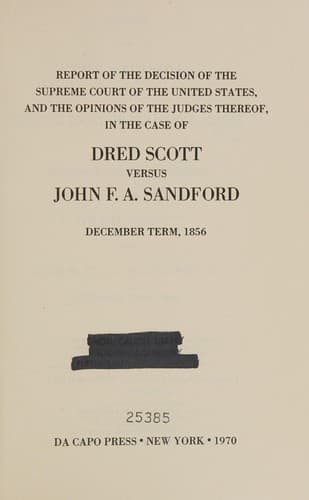
Report of the Decision of the Supreme Court of the United States, and the Opinions of the Judges Thereof, in the Case of Dred Scott versus John F. A. Sandford: December Term, 1856.United States. Supreme Court
History
Report of the Decision of the Supreme Court of the United States, and the Opinions of the Judges Thereof, in the Case of Dred Scott versus John F. A. Sandford: December Term, 1856.
United States. Supreme Court
Scott, Dred, 1809-1858; Slavery -- United States
This sentence is distinguishable from those cited from the French
courts in this: that there positive prohibitions existed against
slavery, and the right to freedom was conferred on the immigrant slave
by positive law; whereas here the consequences of slavery merely--that
is, the public policy--were found to be contrary to the law of
slavery. The case of the slave Grace, (2 Hagg.,) with four others,
came before Lord Stowell in 1827, by appeals from the West India vice
admiralty courts. They were cases of slaves who had returned to those
islands, after a residence in Great Britain, and where the claim to
freedom was first presented in the colonial forum. The learned judge
in that case said: "This suit fails in its foundation. She (Grace) was
not a free person; no injury is done her by her continuance in
slavery, and she has no pretensions to any other station than that
which was enjoyed by every slave of a family. If she depends upon such
freedom conveyed by a mere residence in England, she complains of a
violation of right which she possessed no longer than whilst she
resided in England, but which totally expired when that residence
ceased, and she was imported into Antigua."
The decision of Lord Mansfield was, "that so high an act of dominion"
as the master exercises over his slave, in sending him abroad for
sale, could not be exercised in England under the American laws, and
contrary to the spirit of their own.
The decision of Lord Stowell is, that the authority of the English
laws terminated when the slave departed from England. That the laws of
England were not imported into Antigua, with the slave, upon her
return, and that the colonial forum had no warrant for applying a
foreign code to dissolve relations which had existed between persons
belonging to that island, and which were legal according to its own
system. There is no distinguishable difference between the case before
us and that determined in the admiralty of Great Britain.
The complaint here, in my opinion, amounts to this: that the judicial
tribunals of Missouri have not denounced as odious the Constitution
and laws under which they are organized, and have not superseded them
on their own private authority, for the purpose of applying the laws
of Illinois, or those passed by Congress for Minnesota, in their
stead. The eighth section of the act of Congress of the 6th of March,
1820, (3 Statutes at Large, 545,) entitled, "An act to authorize the
people of Missouri to form a State Government," &c., &c., is referred
to, as affording the authority to this court to pronounce the sentence
which the Supreme Court of Missouri felt themselves constrained to
refuse. That section of the act prohibits slavery in the district of
country west of the Mississippi, north of thirty-six degrees thirty
minutes north latitude, which belonged to the ancient province of
Louisiana, not included in Missouri.
Public-domain text, read in full here on John Shaqi.
Reviews
Reviews
No reviews yet
Be the first to share your thoughts on this work.
Elsewhere in the archive
Join the Discussion
Join the discussion
Sign in to leave a comment or review.
Sign InorCreate an account