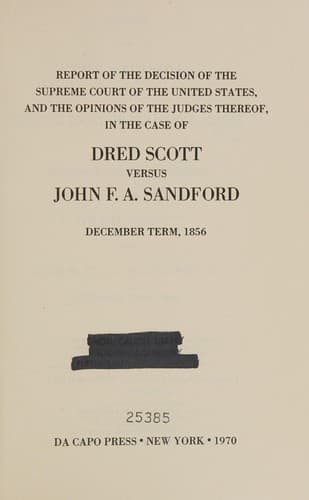
Report of the Decision of the Supreme Court of the United States, and the Opinions of the Judges Thereof, in the Case of Dred Scott versus John F. A. Sandford: December Term, 1856.United States. Supreme Court
History
Report of the Decision of the Supreme Court of the United States, and the Opinions of the Judges Thereof, in the Case of Dred Scott versus John F. A. Sandford: December Term, 1856.
United States. Supreme Court
Scott, Dred, 1809-1858; Slavery -- United States
The question to be raised with the opinion of Lord Mansfield,
therefore, is not in respect to the incongruity of the two systems,
but whether slavery was absolutely contrary to the law of England; for
if it was so, clearly, the American laws could not operate there.
Historical research ascertains that at the date of the Conquest the
rural population of England were generally in a servile condition, and
under various names, denoting slight variances in condition, they were
sold with the land like cattle, and were a part of its living money.
Traces of the existence of African slaves are to be found in the early
chronicles. Parliament in the time of Richard II, and also of Henry
VIII, refused to adopt a general law of emancipation. Acts of
emancipation by the last-named monarch and by Elizabeth are preserved.
The African slave trade had been carried on, under the unbounded
protection of the Crown, for near two centuries, when the case of
Somersett was heard, and no motion for its suppression had ever been
submitted to Parliament; while it was forced upon and maintained in
unwilling colonies by the Parliament and Crown of England at that
moment. Fifteen thousand negro slaves were then living in that island,
where they had been introduced under the counsel of the most
illustrious jurists of the realm, and such slaves had been publicly
sold for near a century in the markets of London. In the northern part
of the kingdom of Great Britain there existed a class of from 30,000
to 40,000 persons, of whom the Parliament said, in 1775, (15 George
III, chap. 28,) "many colliers, coal-heavers, and salters, are in a
state of slavery or bondage, bound to the collieries and salt works,
where they work for life, transferable with the collieries and salt
works when their original masters have no use for them; and whereas
the emancipating or setting free the colliers, coal-heavers, and
salters, in Scotland, who are now in a state of servitude, gradually
and upon reasonable conditions, would be the means of increasing the
number of colliers, coal-heavers, and salters, to the great benefit of
the public, without doing any injury to the present masters, and would
remove the reproach of allowing such a state of servitude to exist in
a free country," &c.; and again, in 1799, "they declare that many
colliers and coal-heavers still continue in a state of bondage." No
statute, from the Conquest till the 15 George III, had been passed
upon the subject of personal slavery. These facts have led the most
eminent civilian of England to question the accuracy of this judgment,
and to insinuate that in this judgment the offence of _ampliare
jurisdictionem_ by private authority was committed by the eminent
magistrate who pronounced it.
Public-domain text, read in full here on John Shaqi.
Reviews
Reviews
No reviews yet
Be the first to share your thoughts on this work.
Elsewhere in the archive
Join the Discussion
Join the discussion
Sign in to leave a comment or review.
Sign InorCreate an account