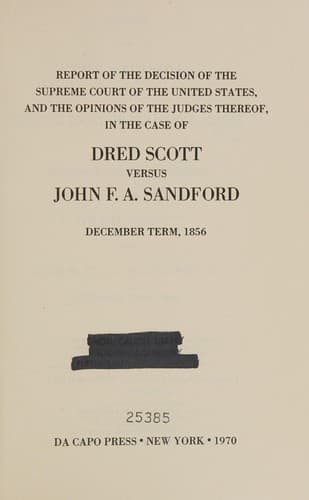
Report of the Decision of the Supreme Court of the United States, and the Opinions of the Judges Thereof, in the Case of Dred Scott versus John F. A. Sandford: December Term, 1856.United States. Supreme Court
History
Report of the Decision of the Supreme Court of the United States, and the Opinions of the Judges Thereof, in the Case of Dred Scott versus John F. A. Sandford: December Term, 1856.
United States. Supreme Court
Scott, Dred, 1809-1858; Slavery -- United States
This ordinance was addressed to the inhabitants as a fundamental
compact, and six of its articles define the conditions to be observed
in their Constitution and laws. These conditions were designed to
fulfil the trust in the agreements of cession, that the States to be
formed of the ceded Territories should be "distinct republican
States." This ordinance was submitted to Virginia in 1788, and the 5th
article, embodying as it does a summary of the entire act, was
specifically ratified and confirmed by that State. This was an
incorporation of the ordinance into her act of cession. It was
conceded, in the argument, that the authority of Congress was not
adequate to the enactment of the ordinance, and that it cannot be
supported upon the Articles of Confederation. To a part of the
engagements, the assent of nine States was required, and for another
portion no provision had been made in those articles. Mr. Madison
said, in a writing nearly contemporary, but before the confirmatory
act of Virginia, "Congress have proceeded to form new States, to erect
temporary Governments, to appoint officers for them, and to prescribe
the conditions on which such States shall be admitted into the
Confederacy; all this has been done, and done without the least color
of constitutional authority." (Federalist, No. 38.) Richard Henry Lee,
one of the committee who reported the ordinance to Congress,
transmitted it to General Washington, (15th July, 1787,) saying, "It
seemed necessary, for the security of property among uninformed and
perhaps licentious people, as the greater part of those who go there
are, that a strong-toned Government should exist, and the rights of
property be clearly defined." The consent of all the States
represented in Congress, the consent of the Legislature of Virginia,
the consent of the inhabitants of the Territory, all concur to support
the authority of this enactment. It is apparent, in the frame of the
Constitution, that the Convention recognised its validity, and
adjusted parts of their work with reference to it. The authority to
admit new States into the Union, the omission to provide distinctly
for Territorial Governments, and the clause limiting the foreign slave
trade to States then existing, which might not prohibit it, show that
they regarded this Territory as provided with a Government, and
organized permanently with a restriction on the subject of slavery.
Justice Chase, in the opinion already cited, says of the Government
before, and it is in some measure true during the Confederation, that
"the powers of Congress originated from necessity, and arose out of
and were only limited by events, or, in other words, they were
revolutionary in their very nature. Their extent depended upon the
exigencies and necessities of public affairs;" and there is only one
rule of construction, in regard to the acts done, which will fully
support them, viz: that the powers actually exercised were rightfully
Public-domain text, read in full here on John Shaqi.
Reviews
Reviews
No reviews yet
Be the first to share your thoughts on this work.
Elsewhere in the archive
Join the Discussion
Join the discussion
Sign in to leave a comment or review.
Sign InorCreate an account