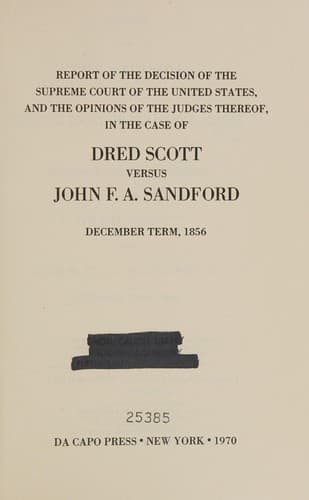
Report of the Decision of the Supreme Court of the United States, and the Opinions of the Judges Thereof, in the Case of Dred Scott versus John F. A. Sandford: December Term, 1856.United States. Supreme Court
History
Report of the Decision of the Supreme Court of the United States, and the Opinions of the Judges Thereof, in the Case of Dred Scott versus John F. A. Sandford: December Term, 1856.
United States. Supreme Court
Scott, Dred, 1809-1858; Slavery -- United States
exercised, wherever they were supported by the implied sanction of the
State Legislatures, and by the ratifications of the people.
The clauses in the 3d section of the 4th article of the Constitution,
relative to the admission of new States, and the disposal and
regulation of the territory of the United States, were adopted without
debate in the Convention.
There was a warm discussion on the clauses that relate to the
subdivision of the States, and the reservation of the claims of the
United States and each of the States from any prejudice. The Maryland
members revived the controversy in regard to the Crown lands of the
Southwest. There was nothing to indicate any reference to a government
of Territories not included within the limits of the Union; and the
whole discussion demonstrates that the Convention was consciously
dealing with a Territory whose condition, as to government, had been
arranged by a fundamental and unalterable compact.
An examination of this clause of the Constitution, by the light of the
circumstances in which the Convention was placed, will aid us to
determine its significance. The first clause is, "that new States may
be admitted by the Congress to this Union." The condition of
Kentucky, Vermont, Rhode Island, and the new States to be formed in
the Northwest, suggested this, as a necessary addition to the powers
of Congress. The next clause, providing for the subdivision of States,
and the parties to consent to such an alteration, was required, by the
plans on foot, for changes in Massachusetts, New York, Pennsylvania,
North Carolina, and Georgia. The clause which enables Congress to
dispose of and make regulations respecting the public domain, was
demanded by the exigencies of an exhausted treasury and a disordered
finance, for relief by sales, and the preparation for sales, of the
public lands; and the last clause, that nothing in the Constitution
should prejudice the claims of the United States or a particular
State, was to quiet the jealousy and irritation of those who had
claimed for the United States all the unappropriated lands. I look in
vain, among the discussions of the time, for the assertion of a
supreme sovereignty for Congress over the territory then belonging to
the United States, or that they might thereafter acquire. I seek in
vain for an annunciation that a consolidated power had been
inaugurated, whose subject comprehended an empire, and which had no
restriction but the discretion of Congress. This disturbing element of
the Union entirely escaped the apprehensive previsions of Samuel
Adams, George Clinton, Luther Martin, and Patrick Henry; and, in
respect to dangers from power vested in a central Government over
distant settlements, colonies, or provinces, their instincts were
always alive. Not a word escaped them, to warn their countrymen, that
here was a power to threaten the landmarks of this federative Union,
and with them the safeguards of popular and constitutional liberty; or
Public-domain text, read in full here on John Shaqi.
Reviews
Reviews
No reviews yet
Be the first to share your thoughts on this work.
Elsewhere in the archive
Join the Discussion
Join the discussion
Sign in to leave a comment or review.
Sign InorCreate an account