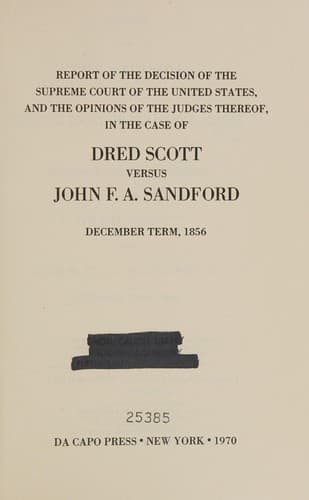
Report of the Decision of the Supreme Court of the United States, and the Opinions of the Judges Thereof, in the Case of Dred Scott versus John F. A. Sandford: December Term, 1856.United States. Supreme Court
History
Report of the Decision of the Supreme Court of the United States, and the Opinions of the Judges Thereof, in the Case of Dred Scott versus John F. A. Sandford: December Term, 1856.
United States. Supreme Court
Scott, Dred, 1809-1858; Slavery -- United States
that under this article there might be introduced, on our soil, a
single Government over a vast extent of country--a Government foreign
to the persons over whom it might be exercised, and capable of binding
those not represented, by statutes, in all cases whatever. I find
nothing to authorize these enormous pretensions, nothing in the
expositions of the friends of the Constitution, nothing in the
expressions of alarm by its opponents--expressions which have since
been developed as prophecies. Every portion of the United States was
then provided with a municipal Government, which this Constitution was
not designed to supersede, but merely to modify as to its conditions.
The compacts of cession by North Carolina and Georgia are subsequent
to the Constitution. They adopt the ordinance of 1787, except the
clause respecting slavery. But the precautionary repudiation of that
article forms an argument quite as satisfactory to the advocates for
Federal power, as its introduction would have done. The refusal of a
power to Congress to legislate in one place, seems to justify the
seizure of the same power when another place for its exercise is
found.
This proceeds from a radical error, which lies at the foundation of
much of this discussion. It is, that the Federal Government may
lawfully do whatever is not directly prohibited by the Constitution.
This would have been a fundamental error, if no amendments to the
Constitution had been made. But the final expression of the will of
the people of the States, in the 10th amendment, is, that the powers
of the Federal Government are limited to the grants of the
Constitution.
Before the cession of Georgia was made, Congress asserted rights, in
respect to a part of her territory, which require a passing notice. In
1798 and 1800, acts for the settlement of limits with Georgia, and to
establish a Government in the Mississippi Territory, were adopted. A
Territorial Government was organized, between the Chattahoochee and
Mississippi rivers. This was within the limits of Georgia. These acts
dismembered Georgia. They established a separate Government upon her
soil, while they rather derisively professed, "that the establishment
of that Government shall in no respects impair the rights of the State
of Georgia, either to the jurisdiction or soil of the Territory." The
Constitution provided that the importation of such persons as any of
the existing States shall think proper to admit, shall not be
prohibited by Congress before 1808. By these enactments, a prohibition
was placed upon the importation of slaves into Georgia, although her
Legislature had made none.
Public-domain text, read in full here on John Shaqi.
Reviews
Reviews
No reviews yet
Be the first to share your thoughts on this work.
Elsewhere in the archive
Join the Discussion
Join the discussion
Sign in to leave a comment or review.
Sign InorCreate an account