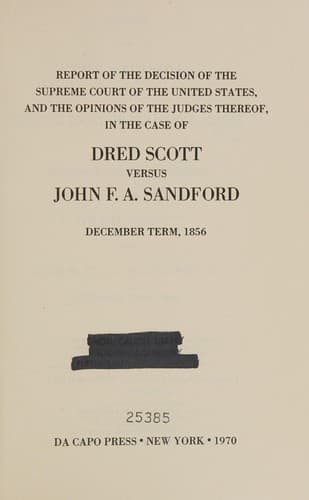
Report of the Decision of the Supreme Court of the United States, and the Opinions of the Judges Thereof, in the Case of Dred Scott versus John F. A. Sandford: December Term, 1856.United States. Supreme Court
History
Report of the Decision of the Supreme Court of the United States, and the Opinions of the Judges Thereof, in the Case of Dred Scott versus John F. A. Sandford: December Term, 1856.
United States. Supreme Court
Scott, Dred, 1809-1858; Slavery -- United States
But there was great difficulty in finding constitutional authority for
the measure. The third section of the fourth article of the
Constitution was introduced into the Constitution, on the motion of
Mr. Gouverneur Morris. In 1803, he was appealed to for information in
regard to its meaning. He answers: "I am very certain I had it not in
contemplation to insert a decree _de coercendo imperio_ in the
Constitution of America.... I knew then, as well as I do now, that all
North America must at length be annexed to us. Happy indeed, if the
lust of dominion stop here. It would therefore have been perfectly
utopian to oppose a paper restriction to the violence of popular
sentiment, in a popular Government." (3 Mor. Writ., 185.) A few days
later, he makes another reply to his correspondent. "I perceive," he
says, "I mistook the drift of your inquiry, which substantially is,
whether Congress can admit, as a new State, territory which did not
belong to the United States when the Constitution was made. In my
opinion, they cannot. I always thought, when we should acquire Canada
and Louisiana, it would be proper to GOVERN THEM AS PROVINCES, AND
ALLOW THEM NO VOICE _in our councils. In wording the third_ SECTION OF
THE _fourth article, I went as far as circumstances would permit, to
establish the exclusion_. CANDOR OBLIGES ME TO ADD MY BELIEF, THAT HAD
IT BEEN MORE POINTEDLY EXPRESSED, A STRONG OPPOSITION WOULD HAVE BEEN
MADE." (3 Mor. Writ., 192.) The first Territorial Government of
Louisiana was an Imperial one, founded upon a French or Spanish model.
For a time, the Governor, Judges, Legislative Council, Marshal,
Secretary, and officers of the militia, were appointed by the
President.[3]
[Footnote 3: Mr. Varnum said: "The bill provided such a Government as
had never been known in the United States." Mr. Eustis: "The
Government laid down in this bill is certainly a new thing in the
United States." Mr. Lucas: "It has been remarked, that this bill
establishes elementary principles never previously introduced in the
Government of any Territory of the United States. Granting the truth
of this observation," &c., &c. Mr. Macon: "My first objection to the
principle contained in this section is, that it establishes a species
of government unknown to the United States." Mr. Boyle: "Were the
President an angel instead of a man, I would not clothe him with this
power." Mr. G.W. Campbell: "On examining the section, it will appear
that it really establishes a complete despotism." Mr. Sloan: "Can
anything be more repugnant to the principles of just government? Can
anything be more despotic?"--_Annals of Congress_, 1803-'4.]
Public-domain text, read in full here on John Shaqi.
Reviews
Reviews
No reviews yet
Be the first to share your thoughts on this work.
Elsewhere in the archive
Join the Discussion
Join the discussion
Sign in to leave a comment or review.
Sign InorCreate an account