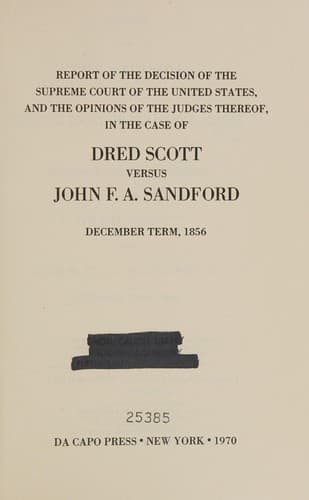
Report of the Decision of the Supreme Court of the United States, and the Opinions of the Judges Thereof, in the Case of Dred Scott versus John F. A. Sandford: December Term, 1856.United States. Supreme Court
History
Report of the Decision of the Supreme Court of the United States, and the Opinions of the Judges Thereof, in the Case of Dred Scott versus John F. A. Sandford: December Term, 1856.
United States. Supreme Court
Scott, Dred, 1809-1858; Slavery -- United States
Besides these anomalous arrangements, the acquisition gave rise to
jealous inquiries, as to the influence it would exert in determining
the men and States that were to be "the arbiters and rulers" of the
destinies of the Union; and unconstitutional opinions, having for
their aim to promote sectional divisions, were announced and
developed. "Something," said an eminent statesman, "something has
suggested to the members of Congress the policy of acquiring
geographical majorities. This is a very direct step towards disunion,
for it must foster the geographical enmities by which alone it can be
effected. This something must be a contemplation of particular
advantages to be derived from such majorities; and is it not notorious
that they consist of nothing else but usurpations over persons and
property, by which they can regulate the internal _wealth and
prosperity of States and individuals_?"
The most dangerous of the efforts to employ a geographical political
power, to perpetuate a geographical preponderance in the Union, is to
be found in the deliberations upon the act of the 6th of March, 1820,
before cited. The attempt consisted of a proposal to exclude Missouri
from a place in the Union, unless her people would adopt a
Constitution containing a prohibition upon the subject of slavery,
according to a prescription of Congress. The sentiment is now general,
if not universal, that Congress had no constitutional power to impose
the restriction. This was frankly admitted at the bar, in the course
of this argument. The principles which this court have pronounced
condemn the pretension then made on behalf of the legislative
department. In Groves _v._ Slaughter, (15 Pet.,) the Chief Justice
said: "The power over this subject is exclusively with the several
States, and each of them has a right to decide for itself whether it
will or will not allow persons of this description to be brought
within its limits." Justice McLean said: "The Constitution of the
United States operates alike in all the States, and one State has the
same power over the subject of slavery as every other State." In
Pollard's Lessee _v._ Hagan, (3 How., 212,) the court say: "The United
States have no constitutional capacity to exercise municipal
jurisdiction, sovereignty, or eminent domain, within the limits of a
State or elsewhere, except in cases where it is delegated, and the
court denies the faculty of the Federal Government to add to its
powers by treaty or compact."
Public-domain text, read in full here on John Shaqi.
Reviews
Reviews
No reviews yet
Be the first to share your thoughts on this work.
Elsewhere in the archive
Join the Discussion
Join the discussion
Sign in to leave a comment or review.
Sign InorCreate an account