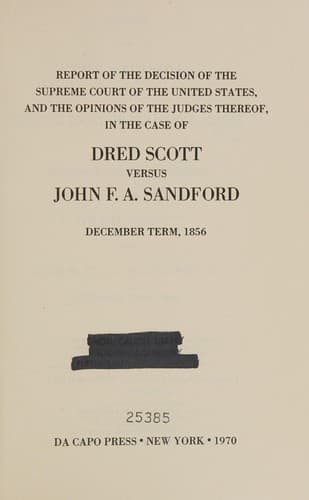
Report of the Decision of the Supreme Court of the United States, and the Opinions of the Judges Thereof, in the Case of Dred Scott versus John F. A. Sandford: December Term, 1856.United States. Supreme Court
History
Report of the Decision of the Supreme Court of the United States, and the Opinions of the Judges Thereof, in the Case of Dred Scott versus John F. A. Sandford: December Term, 1856.
United States. Supreme Court
Scott, Dred, 1809-1858; Slavery -- United States
To impair or diminish either, the department must produce an authority
from the people themselves, in their Constitution; and, as we have
seen, a power to make rules and regulations respecting the public
domain does not confer a municipal sovereignty over persons and things
upon it. But as this is "thought their fort" by our adversaries, I
propose a more definite examination of it. We have seen, Congress does
not dispose of or make rules and regulations respecting domain
belonging to themselves, but belonging to the United States.
These conferred on their mandatory, Congress, authority to dispose of
the territory which belonged to them in common; and to accomplish that
object beneficially and effectually, they gave an authority to make
suitable rules and regulations respecting it. When the power of
disposition is fulfilled, the authority to make rules and regulations
terminates, for it attaches only upon territory "belonging to the
United States."
Consequently, the power to make rules and regulations, from the nature
of the subject, is restricted to such administrative and conservatory
acts as are needful for the preservation of the public domain, and its
preparation for sale or disposition. The system of land surveys; the
reservations for schools, internal improvements, military sites, and
public buildings; the pre-emption claims of settlers; the
establishment of land offices, and boards of inquiry, to determine the
validity of land titles; the modes of entry, and sale, and of
conferring titles; the protection of the lands from trespass and
waste; the partition of the public domain into municipal subdivisions,
having reference to the erection of Territorial Governments and
States; and perhaps the selection, under their authority, of suitable
laws for the protection of the settlers, until there may be a
sufficient number of them to form a self-sustaining municipal
Government--these important rules and regulations will sufficiently
illustrate the scope and operation of the 3d section of the 4th
article of the Constitution. But this clause in the Constitution does
not exhaust the powers of Congress within the territorial
subdivisions, or over the persons who inhabit them. Congress may
exercise there all the powers of Government which belong to them as
the Legislature of the United States, of which these Territories make
a part. (Loughborough _v._ Blake, 5 Wheat., 317.) Thus the laws of
taxation, for the regulation of foreign, Federal, and Indian commerce,
and so for the abolition of the slave trade, for the protection of
copyrights and inventions, for the establishment of postal
communication and courts of justice, and for the punishment of crimes,
are as operative there as within the States. I admit that to mark the
bounds for the jurisdiction of the Government of the United States
within the Territory, and of its power in respect to persons and
things within the municipal subdivisions it has created, is a work of
Public-domain text, read in full here on John Shaqi.
Reviews
Reviews
No reviews yet
Be the first to share your thoughts on this work.
Elsewhere in the archive
Join the Discussion
Join the discussion
Sign in to leave a comment or review.
Sign InorCreate an account