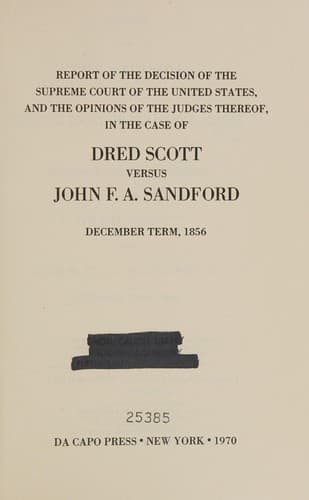
Report of the Decision of the Supreme Court of the United States, and the Opinions of the Judges Thereof, in the Case of Dred Scott versus John F. A. Sandford: December Term, 1856.United States. Supreme Court
History
Report of the Decision of the Supreme Court of the United States, and the Opinions of the Judges Thereof, in the Case of Dred Scott versus John F. A. Sandford: December Term, 1856.
United States. Supreme Court
Scott, Dred, 1809-1858; Slavery -- United States
Mr. John Quincy Adams, at a later period, says of the last act, "that
the President found Congress mounted to the pitch of passing those
acts, without inquiring where they acquired the authority, and he
conquered his own scruples as they had done theirs." But this court
cannot undertake for themselves the same conquest. They acknowledge
that our peculiar security is in the possession of a written
Constitution, and they cannot make it blank paper by construction.
They look to its delineation of the operations of the Federal
Government, and they must not exceed the limits it marks out, in their
administration. The court have said "that Congress cannot exercise
municipal jurisdiction, sovereignty, or eminent domain, within the
limits of a State or elsewhere, beyond what has been delegated." We
are then to find the authority for supreme power in the Territories in
the Constitution. What are the limits upon the operations of a
Government invested with legislative, executive, and judiciary powers,
and charged with the power to dispose of and to make all needful rules
and regulations respecting a vast public domain? The feudal system
would have recognised the claim made on behalf of the Federal
Government for supreme power over persons and things in the
Territories, as an incident to this title--that is, the title to
dispose of and make rules and regulations respecting it.
The Norman lawyers of William the Conqueror would have yielded an
implicit assent to the doctrine, that a supreme sovereignty is an
inseparable incident to a grant to dispose of and to make all needful
rules and regulations respecting the public domain. But an American
patriot, in contrasting the European and American systems, may affirm,
"that European sovereigns give lands to their colonists, but reserve
to themselves a power to control their property, liberty, and
privileges; but the American Government sells the lands belonging to
the people of the several States (i.e., United States) to their
citizens, who are already in the possession of personal and political
rights, which the Government did not give, and cannot take away." And
the advocates for Government sovereignty in the Territories have been
compelled to abate a portion of the pretensions originally made in its
behalf, and to admit that the constitutional prohibitions upon
Congress operate in the Territories. But a constitutional prohibition
is not requisite to ascertain a limitation upon the authority of the
several departments of the Federal Government. Nor are the States or
people restrained by any enumeration or definition of their rights or
liberties.
Public-domain text, read in full here on John Shaqi.
Reviews
Reviews
No reviews yet
Be the first to share your thoughts on this work.
Elsewhere in the archive
Join the Discussion
Join the discussion
Sign in to leave a comment or review.
Sign InorCreate an account