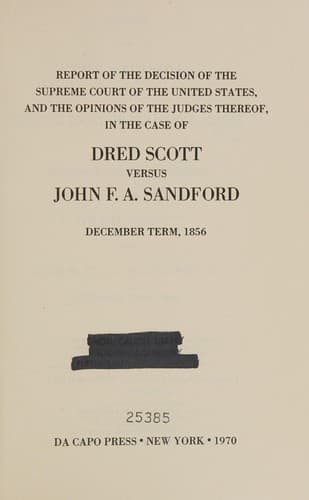
Report of the Decision of the Supreme Court of the United States, and the Opinions of the Judges Thereof, in the Case of Dred Scott versus John F. A. Sandford: December Term, 1856.United States. Supreme Court
History
Report of the Decision of the Supreme Court of the United States, and the Opinions of the Judges Thereof, in the Case of Dred Scott versus John F. A. Sandford: December Term, 1856.
United States. Supreme Court
Scott, Dred, 1809-1858; Slavery -- United States
In the opinion of the court, the legislation and histories of the
times, and the language used in the Declaration of Independence, show,
that neither the class of persons who had been imported as slaves, nor
their descendants, whether they had become free or not, were then
acknowledged as a part of the people, nor intended to be included in
the general words used in that memorable instrument.
It is difficult at this day to realize the state of public opinion in
relation to that unfortunate race, which prevailed in the civilized
and enlightened portions of the world at the time of the Declaration
of Independence, and when the Constitution of the United States was
framed and adopted. But the public history of every European nation
displays it in a manner too plain to be mistaken.
They had for more than a century before been regarded as beings of an
inferior order, and altogether unfit to associate with the white race,
either in social or political relations; and so far inferior, that
they had no rights which the white man was bound to respect; and that
the negro might justly and lawfully be reduced to slavery for his
benefit. He was bought and sold, and treated as an ordinary article of
merchandise and traffic, whenever a profit could be made by it. This
opinion was at that time fixed and universal in the civilized portion
of the white race. It was regarded as an axiom in morals as well as in
politics, which no one thought of disputing, or supposed to be open to
dispute; and men in every grade and position in society daily and
habitually acted upon it in their private pursuits, as well as in
matters of public concern, without doubting for a moment the
correctness of this opinion.
And in no nation was this opinion more firmly fixed or more uniformly
acted upon than by the English Government and English people. They not
only seized them on the coast of Africa, and sold them or held them in
slavery for their own use; but they took them as ordinary articles of
merchandise to every country where they could make a profit on them,
and were far more extensively engaged in this commerce than any other
nation in the world.
The opinion thus entertained and acted upon in England was naturally
impressed upon the colonies they founded on this side of the Atlantic.
And, accordingly, a negro of the African race was regarded by them as
an article of property, and held, and bought and sold as such, in
every one of the thirteen colonies which united in the Declaration of
Independence, and afterwards formed the Constitution of the United
States. The slaves were more or less numerous in the different
colonies, as slave labor was found more or less profitable. But no one
seems to have doubted the correctness of the prevailing opinion of the
time.
The legislation of the different colonies furnishes positive and
indisputable proof of this fact.
Public-domain text, read in full here on John Shaqi.
Reviews
Reviews
No reviews yet
Be the first to share your thoughts on this work.
Join the Discussion
Join the discussion
Sign in to leave a comment or review.
Sign InorCreate an account