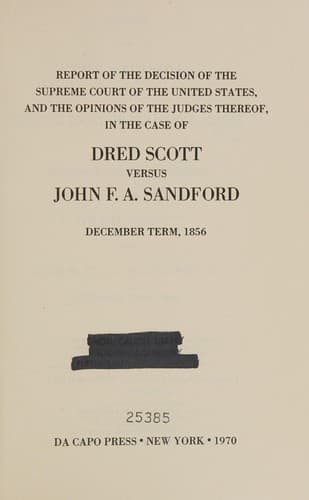
Report of the Decision of the Supreme Court of the United States, and the Opinions of the Judges Thereof, in the Case of Dred Scott versus John F. A. Sandford: December Term, 1856.United States. Supreme Court
History
Report of the Decision of the Supreme Court of the United States, and the Opinions of the Judges Thereof, in the Case of Dred Scott versus John F. A. Sandford: December Term, 1856.
United States. Supreme Court
Scott, Dred, 1809-1858; Slavery -- United States
The declaration discloses a case within the jurisdiction of the
court--a controversy between citizens of different States. The plea in
abatement, impugning these jurisdictional averments, was waived when
the defendant answered to the declaration by pleas to the merits. The
proceedings on that plea remain a part of the technical record, to
show the history of the case, but are not open to the review of this
court by a writ of error. The authorities are very conclusive on this
point. Shepherd _v._ Graves, 14 How., 505; Bailey _v._ Dozier, 6 How.,
23; 1 Stewart, (Alabama,) 46; 10 Ben. Monroe, (Kentucky,) 555; 2
Stewart, (Alabama,) 370, 443; 2 Scammon, (Illinois,) 78. Nor can the
court assume, as admitted facts, the averments of the plea from the
confession of the demurrer. That confession was for a single object,
and cannot be used for any other purpose than to test the validity of
the plea. Tompkins _v._ Ashley, 1 Moody and Mackin, 32; 33 Maine, 96,
100.
There being nothing in controversy here but the merits, I will proceed
to discuss them.
The plaintiff claims to have acquired property in himself, and became
free, by being kept in Illinois during two years.
The Constitution, laws, and policy, of Illinois, are somewhat peculiar
respecting slavery. Unless the master becomes an inhabitant of that
State, the slaves he takes there do not acquire their freedom; and if
they return with their master to the slave State of his domicil, they
cannot assert their freedom after their return. For the reasons and
authorities on this point, I refer to the opinion of my brother
Nelson, with which I not only concur, but think his opinion is the
most conclusive argument on the subject within my knowledge.
It is next insisted for the plaintiff, that his freedom (and that of
his wife and eldest child) was obtained by force of the act of
Congress of 1820, usually known as the Missouri compromise act, which
declares: "That in all that territory ceded by France to the United
States, which lies north of thirty-six degrees thirty minutes north
latitude, slavery and involuntary servitude shall be, and are hereby,
_forever prohibited_."
From this prohibition, the territory now constituting the State of
Missouri was excepted; which exception to the stipulation gave it the
designation of a compromise.
The first question presented on this act is, whether Congress had
power to make such compromise. For, if power was wanting, then no
freedom could be acquired by the defendant under the act.
Public-domain text, read in full here on John Shaqi.
Reviews
Reviews
No reviews yet
Be the first to share your thoughts on this work.
Elsewhere in the archive
Join the Discussion
Join the discussion
Sign in to leave a comment or review.
Sign InorCreate an account