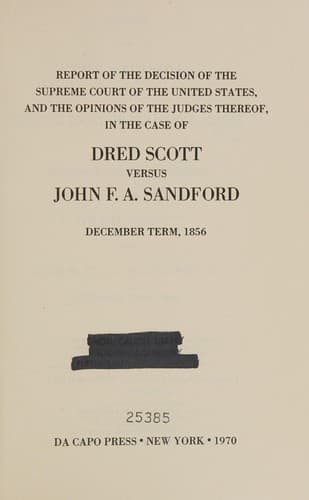
Report of the Decision of the Supreme Court of the United States, and the Opinions of the Judges Thereof, in the Case of Dred Scott versus John F. A. Sandford: December Term, 1856.United States. Supreme Court
History
Report of the Decision of the Supreme Court of the United States, and the Opinions of the Judges Thereof, in the Case of Dred Scott versus John F. A. Sandford: December Term, 1856.
United States. Supreme Court
Scott, Dred, 1809-1858; Slavery -- United States
That Congress has no authority to pass laws and bind men's rights
beyond the powers conferred by the Constitution, is not open to
controversy. But it is insisted that, by the Constitution, Congress
has power to legislate for and govern the Territories of the United
States, and that by force of the power to govern, laws could be
enacted, prohibiting slavery in any portion of the Louisiana
Territory; and, of course, to abolish slavery _in all_ parts of it,
whilst it was, or is, governed as a Territory.
My opinion is, that Congress is vested with power to govern the
Territories of the United States by force of the third section of the
fourth article of the Constitution. And I will state my reasons for
this opinion.
Almost every provision in that instrument has a history that must be
understood, before the brief and sententious language employed can be
comprehended in the relations its authors intended. We must bring
before us the state of things presented to the Convention, and in
regard to which it acted, when the compound provision was made,
declaring: 1st. That "new States may be admitted by the Congress into
this Union." 2d. "The Congress shall have power to dispose of and make
all needful rules and regulations respecting the territory or other
property belonging to the United States. And nothing in this
Constitution shall be so construed as to prejudice any claims of the
United States, or any particular State."
Having ascertained the historical facts giving rise to these
provisions, the difficulty of arriving at the true meaning of the
language employed will be greatly lessened.
The history of these facts is substantially as follows:
The King of Great Britain, by his proclamation of 1763, virtually
claimed that the country west of the mountains had been conquered from
France, and ceded to the Crown of Great Britain by the treaty of Paris
of that year, and he says: "We reserve it under our sovereignty,
protection, and dominion, for the use of the Indians."
This country was conquered from the Crown of Great Britain, and
surrendered to the United States by the treaty of peace of 1783. The
colonial charters of Virginia, North Carolina, and Georgia, included
it. Other States set up pretensions of claim to some portions of the
territory north of the Ohio, but they were of no value, as I suppose.
(5 Wheat., 375.)
Public-domain text, read in full here on John Shaqi.
Reviews
Reviews
No reviews yet
Be the first to share your thoughts on this work.
Elsewhere in the archive
Join the Discussion
Join the discussion
Sign in to leave a comment or review.
Sign InorCreate an account