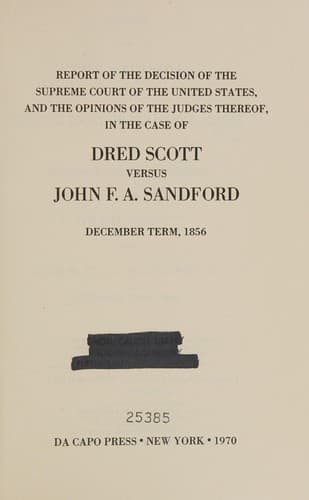
Report of the Decision of the Supreme Court of the United States, and the Opinions of the Judges Thereof, in the Case of Dred Scott versus John F. A. Sandford: December Term, 1856.United States. Supreme Court
History
Report of the Decision of the Supreme Court of the United States, and the Opinions of the Judges Thereof, in the Case of Dred Scott versus John F. A. Sandford: December Term, 1856.
United States. Supreme Court
Scott, Dred, 1809-1858; Slavery -- United States
The Missouri compromise line of 1820 was very aggressive; it declared
that slavery was abolished forever throughout a country reaching from
the Mississippi river to the Pacific ocean, stretching over thirty-two
degrees of longitude, and twelve and a half degrees of latitude on its
eastern side, sweeping over four-fifths, to say no more, of the
original province of Louisiana.
That the United States Government stipulated in favor of the
inhabitants to the extent here contended for, has not been seriously
denied, as far as I know; but the argument is, that Congress had
authority to _repeal_ the third article of the treaty of 1803, in so
far as it secured the right to hold slave property, in a portion of
the ceded territory, leaving the right to exist in other parts. In
other words, that Congress could repeal the third article entirely, at
its pleasure. This I deny.
The compacts with North Carolina and Georgia were treaties also, and
stood on the same footing of the Louisiana treaty; on the assumption
of power to repeal the one, it must have extended to all, and Congress
could have excluded the slaveholder of North Carolina from the
enjoyment of his lands in the Territory now the State of Tennessee,
where the citizens of the mother State were the principal proprietors.
And so in the case of Georgia. Her citizens could have been refused
the right to emigrate to the Mississippi or Alabama Territory, unless
they left their most valuable and cherished property behind them.
The Constitution was framed in reference to facts then existing or
likely to arise: the instrument looked to no theories of Government.
In the vigorous debates in the Convention, as reported by Mr. Madison
and others, surrounding facts, and the condition and necessities of
the country, gave rise to almost every provision; and among those
facts, it was prominently true, that Congress dare not be intrusted
with power to provide that, if North Carolina or Georgia ceded her
western territory, the citizens of the State (in either case) could be
prohibited, at the pleasure of Congress, from removing to their lands,
then granted to a large extent, in the country likely to be ceded,
unless they left their slaves behind. That such an attempt, in the
face of a population fresh from the war of the Revolution, and then
engaged in war with the great confederacy of Indians, extending from
the mouth of the Ohio to the Gulf of Mexico, would end in open revolt,
all intelligent men knew.
Public-domain text, read in full here on John Shaqi.
Reviews
Reviews
No reviews yet
Be the first to share your thoughts on this work.
Elsewhere in the archive
Join the Discussion
Join the discussion
Sign in to leave a comment or review.
Sign InorCreate an account