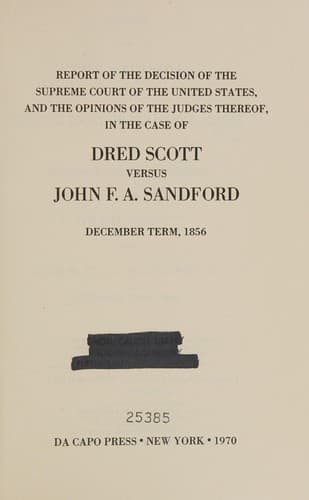
Report of the Decision of the Supreme Court of the United States, and the Opinions of the Judges Thereof, in the Case of Dred Scott versus John F. A. Sandford: December Term, 1856.United States. Supreme Court
History
Report of the Decision of the Supreme Court of the United States, and the Opinions of the Judges Thereof, in the Case of Dred Scott versus John F. A. Sandford: December Term, 1856.
United States. Supreme Court
Scott, Dred, 1809-1858; Slavery -- United States
Louisiana was a province where slavery was not only lawful, but where
property in slaves was the most valuable of all personal property. The
province was ceded as a unit, with an equal right pertaining to all
its inhabitants, in every part thereof, to own slaves. It was, to a
great extent, a vacant country, having in it few civilized
inhabitants. No one portion of the colony, of a proper size for a
State of the Union had a sufficient number of inhabitants to claim
admission into the Union. To enable the United States to fulfil the
treaty, additional population was indispensable, and obviously desired
with anxiety by both sides, so that the whole country should, as soon
as possible, become States of the Union. And for this contemplated
future population, the treaty as expressly provided as it did for the
inhabitants residing in the province when the treaty was made. All
these were to be protected "_in the mean time_;" that is to say, at
all times, between the date of the treaty and the time when the
portion of the Territory where the inhabitants resided was admitted
into the Union as a State.
At the date of the treaty, each inhabitant had the right to the _free_
enjoyment of his property, alike with his liberty and his religion, in
every part of Louisiana; the province then being one country, he might
go everywhere in it, and carry his liberty, property, and religion,
with him, and in which he was to be maintained and protected, until he
became a citizen of a State of the Union of the United States. This
cannot be denied to the original inhabitants and their descendants.
And, if it be true that immigrants were equally protected, it must
follow that they can also stand on the treaty.
The settled doctrine in the State courts of Louisiana is, that a
French subject coming to the Orleans Territory, after the treaty of
1803 was made, and before Louisiana was admitted into the Union, and
being an inhabitant at the time of the admission, became a citizen of
the United States by that act; that he was one of the inhabitants
contemplated by the third article of the treaty, which referred to all
the inhabitants embraced within the new State on its admission.
That this is the true construction, I have no doubt.
If power existed to draw a line at thirty-six degrees thirty minutes
north, so Congress had equal power to draw the line on the thirtieth
degree--that is, due west from the city of New Orleans--and to declare
that north of _that line_ slavery should never exist. Suppose this had
been done before 1812, when Louisiana came into the Union, and the
question of infraction of the treaty had then been presented on the
present assumption of power to prohibit slavery, who doubts what the
decision of this court would have been on such an act of Congress;
yet, the difference between the supposed line, and that on thirty-six
degrees thirty minutes north, is only in the degree of grossness
presented by the lower line.
Public-domain text, read in full here on John Shaqi.
Reviews
Reviews
No reviews yet
Be the first to share your thoughts on this work.
Elsewhere in the archive
Join the Discussion
Join the discussion
Sign in to leave a comment or review.
Sign InorCreate an account