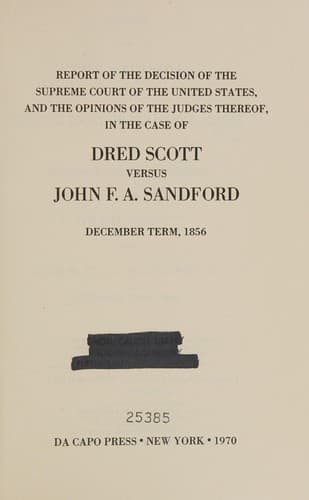
Report of the Decision of the Supreme Court of the United States, and the Opinions of the Judges Thereof, in the Case of Dred Scott versus John F. A. Sandford: December Term, 1856.United States. Supreme Court
History
Report of the Decision of the Supreme Court of the United States, and the Opinions of the Judges Thereof, in the Case of Dred Scott versus John F. A. Sandford: December Term, 1856.
United States. Supreme Court
Scott, Dred, 1809-1858; Slavery -- United States
The decision on the demurrer was in favor of the plaintiff; and as the
plaintiff prosecutes this writ of error, he does not complain of the
decision on the demurrer. The defendant might have complained of this
decision, as against him, and have prosecuted a writ of error, to
reverse it. But as the case, under the instruction of the court to the
jury, was decided in his favor, of course he had no ground of
complaint.
But it is said, if the court, on looking at the record, shall clearly
perceive that the Circuit Court had no jurisdiction, it is a ground
for the dismissal of the case. This may be characterized as rather a
sharp practice, and one which seldom, if ever, occurs. No case was
cited in the argument as authority, and not a single case precisely in
point is recollected in our reports. The pleadings do not show a want
of jurisdiction. This want of jurisdiction can only be ascertained by
a judgment on the demurrer to the special plea. No such case, it is
believed, can be cited. But if this rule of practice is to be applied
in this case, and the plaintiff in error is required to answer and
maintain as well the points ruled in his favor, as to show the error
of those ruled against him, he has more than an ordinary duty to
perform. Under such circumstances, the want of jurisdiction in the
Circuit Court must be so clear as not to admit of doubt. Now, the plea
which raises the question of jurisdiction, in my judgment, is
radically defective. The gravamen of the plea is this: "That the
plaintiff is a negro of African descent, his ancestors being of pure
African blood, and were brought into this country, and sold as negro
slaves."
There is no averment in this plea which shows or conduces to show an
inability in the plaintiff to sue in the Circuit Court. It does not
allege that the plaintiff had his domicil in any other State, nor that
he is not a free man in Missouri. He is averred to have had a negro
ancestry, but this does not show that he is not a citizen of Missouri,
within the meaning of the act of Congress authorizing him to sue in
the Circuit Court. It has never been held necessary, to constitute a
citizen within the act, that he should have the qualifications of an
elector. Females and minors may sue in the Federal courts, and so may
any individual who has a permanent domicil in the State under whose
laws his rights are protected, and to which he owes allegiance.
Being born under our Constitution and laws, no naturalization is
required, as one of foreign birth, to make him a citizen. The most
general and appropriate definition of the term citizen is "a freeman."
Being a freeman, and having his domicil in a State different from that
of the defendant, he is a citizen within the act of Congress, and the
courts of the Union are open to him.
Public-domain text, read in full here on John Shaqi.
Reviews
Reviews
No reviews yet
Be the first to share your thoughts on this work.
Elsewhere in the archive
Join the Discussion
Join the discussion
Sign in to leave a comment or review.
Sign InorCreate an account