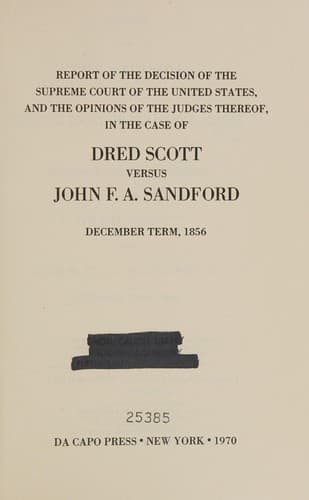
Report of the Decision of the Supreme Court of the United States, and the Opinions of the Judges Thereof, in the Case of Dred Scott versus John F. A. Sandford: December Term, 1856.United States. Supreme Court
History
Report of the Decision of the Supreme Court of the United States, and the Opinions of the Judges Thereof, in the Case of Dred Scott versus John F. A. Sandford: December Term, 1856.
United States. Supreme Court
Scott, Dred, 1809-1858; Slavery -- United States
It has often been held, that the jurisdiction, as regards parties, can
only be exercised between citizens of different States, and that a
mere residence is not sufficient; but this has been said to
distinguish a temporary from a permanent residence.
To constitute a good plea to the jurisdiction, it must negative those
qualities and rights which enable an individual to sue in the Federal
courts. This has not been done; and on this ground the plea was
defective, and the demurrer was properly sustained. No implication can
aid a plea in abatement or in bar; it must be complete in itself; the
facts stated, if true, must abate or bar the right of the plaintiff to
sue. This is not the character of the above plea. The facts stated, if
admitted, are not inconsistent with other facts, which may be
presumed, and which bring the plaintiff within the act of Congress.
The pleader has not the boldness to allege that this plaintiff is a
slave, as that would assume against him the matter in controversy, and
embrace the entire merits of the case in a plea to the jurisdiction.
But beyond the facts set out in the plea, the court, to sustain it,
must assume the plaintiff to be a slave, which is decisive on the
merits. This is a short and an effectual mode of deciding the cause;
but I am yet to learn that it is sanctioned by any known rule of
pleading.
The defendant's counsel complain, that if the court take jurisdiction
on the ground that the plaintiff is free, the assumption is against
the right of the master. This argument is easily answered. In the
first place, the plea does not show him to be a slave; it does not
follow that a man is not free whose ancestors were slaves. The reports
of the Supreme Court of Missouri show that this assumption has many
exceptions; and there is no averment in the plea that the plaintiff is
not within them.
By all the rules of pleading, this is a fatal defect in the plea. If
there be doubt, what rule of construction has been established in the
slave States? In Jacob _v._ Sharp, (Meigs's Rep., Tennessee, 114,) the
court held, when there was doubt as to the construction of a will
which emancipated a slave, "it must be construed to be subordinate to
the higher and more important right of freedom."
No injustice can result to the master, from an exercise of
jurisdiction in this cause. Such a decision does not in any degree
affect the merits of the case; it only enables the plaintiff to assert
his claims to freedom before this tribunal. If the jurisdiction be
ruled against him, on the ground that he is a slave, it is decisive of
his fate.
Public-domain text, read in full here on John Shaqi.
Reviews
Reviews
No reviews yet
Be the first to share your thoughts on this work.
Elsewhere in the archive
Join the Discussion
Join the discussion
Sign in to leave a comment or review.
Sign InorCreate an account