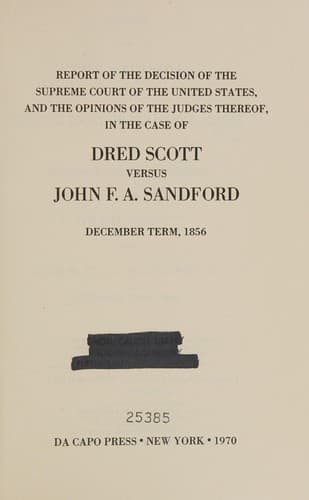
Report of the Decision of the Supreme Court of the United States, and the Opinions of the Judges Thereof, in the Case of Dred Scott versus John F. A. Sandford: December Term, 1856.United States. Supreme Court
History
Report of the Decision of the Supreme Court of the United States, and the Opinions of the Judges Thereof, in the Case of Dred Scott versus John F. A. Sandford: December Term, 1856.
United States. Supreme Court
Scott, Dred, 1809-1858; Slavery -- United States
It has been argued that, if a colored person be made a citizen of a
State, he cannot sue in the Federal court. The Constitution declares
that Federal jurisdiction "may be exercised between citizens of
different States," and the same is provided in the act of 1789. The
above argument is properly met by saying that the Constitution was
intended to be a practical instrument; and where its language is too
plain to be misunderstood, the argument ends.
In Chirae _v._ Chirae, (2 Wheat., 261; 4 Curtis, 99,) this court says:
"That the power of naturalization is exclusively in Congress does not
seem to be, and certainly ought not to be, controverted." No person
can legally be made a citizen of a State, and consequently a citizen
of the United States, of foreign birth, unless he be naturalized under
the acts of Congress. Congress has power "to establish a uniform rule
of naturalization."
It is a power which belongs exclusively to Congress, as intimately
connected with our Federal relations. A State may authorize foreigners
to hold real estate within its jurisdiction, but it has no power to
naturalize foreigners, and give them the rights of citizens. Such a
right is opposed to the acts of Congress on the subject of
naturalization, and subversive of the Federal powers. I regret that
any countenance should be given from this bench to a practice like
this in some of the States, which has no warrant in the Constitution.
In the argument, it was said that a colored citizen would not be an
agreeable member of society. This is more a matter of taste than of
law. Several of the States have admitted persons of color to the right
of suffrage, and in this view have recognised them as citizens; and
this has been done in the slave as well as the free States. On the
question of citizenship, it must be admitted that we have not been
very fastidious. Under the late treaty with Mexico, we have made
citizens of all grades, combinations, and colors. The same was done in
the admission of Louisiana and Florida. No one ever doubted, and no
court ever held, that the people of these Territories did not become
citizens under the treaty. They have exercised all the rights of
citizens, without being naturalized under the acts of Congress.
There are several important principles involved in this case, which
have been argued, and which may be considered under the following
heads:
1. The locality of slavery, as settled by this court and the courts of
the States.
2. The relation which the Federal Government bears to slavery in the
States.
3. The power of Congress to establish Territorial Governments, and to
prohibit the introduction of slavery therein.
4. The effect of taking slaves into a new State or Territory, and so
holding them, where slavery is prohibited.
5. Whether the return of a slave under the control of his master,
after being entitled to his freedom, reduces him to his former
condition.
Public-domain text, read in full here on John Shaqi.
Reviews
Reviews
No reviews yet
Be the first to share your thoughts on this work.
Elsewhere in the archive
Join the Discussion
Join the discussion
Sign in to leave a comment or review.
Sign InorCreate an account