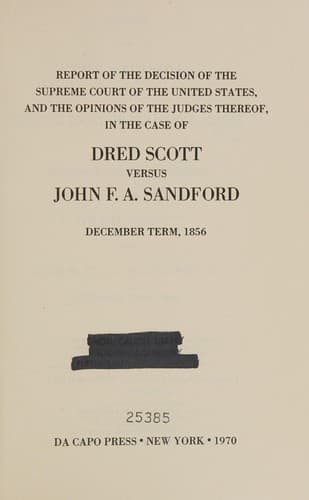
Report of the Decision of the Supreme Court of the United States, and the Opinions of the Judges Thereof, in the Case of Dred Scott versus John F. A. Sandford: December Term, 1856.United States. Supreme Court
History
Report of the Decision of the Supreme Court of the United States, and the Opinions of the Judges Thereof, in the Case of Dred Scott versus John F. A. Sandford: December Term, 1856.
United States. Supreme Court
Scott, Dred, 1809-1858; Slavery -- United States
Can any one suppose that the eminent men of the Federal Convention
could have overlooked or neglected a matter so vitally important to
the country, in the organization of temporary Governments for the vast
territory northwest of the river Ohio? In the 3d section of the 4th
article of the Constitution, they did make provision for the admission
of new States, the sale of the public lands, and the temporary
Government of the territory. Without a temporary Government, new
States could not have been formed, nor could the public lands have
been sold.
If the third section were before us now for consideration for the
first time, under the facts stated, I could not hesitate to say there
was adequate legislative power given in it. The power to make all
needful rules and regulations is a power to legislate. This no one
will controvert, as Congress cannot make "rules and regulations,"
except by legislation. But it is argued that the word territory is
used as synonymous with the word land; and that the rules and
regulations of Congress are limited to the disposition of lands and
other property belonging to the United States. That this is not the
true construction of the section appears from the fact that in the
first line of the section "the power to dispose of the public lands"
is given expressly, and, in addition, to make all needful rules and
regulations. The power to dispose of is complete in itself, and
requires nothing more. It authorizes Congress to use the proper means
within its discretion, and any further provision for this purpose
would be a useless verbiage. As a composition, the Constitution is
remarkably free from such a charge.
In the discussion of the power of Congress to govern a Territory, in
the case of the Atlantic Insurance Company _v._ Canter, (1 Peters,
511; 7 Curtis, 685,) Chief Justice Marshall, speaking for the court,
said, in regard to the people of Florida, "they do not, however,
participate in political power; they do not share in the Government
till Florida shall become a State; in the mean time, Florida continues
to be a Territory of the United States, governed by virtue of that
clause in the Constitution which empowers Congress 'to make all
needful rules and regulations respecting the territory or other
property belonging to the United States.'"
And he adds, "perhaps the power of governing a Territory belonging to
the United States, which has not, by becoming a State, acquired the
means of self-government, may result necessarily from the fact that
it is not within the jurisdiction of any particular State, and is
within the power and jurisdiction of the United States. The right to
govern may be the inevitable consequence of the right to acquire
territory; whichever may be the source whence the power is derived,
the possession of it is unquestioned." And in the close of the
opinion, the court say, "in legislating for them [the Territories,]
Congress exercises the combined powers of the General and State
Governments."
Public-domain text, read in full here on John Shaqi.
Reviews
Reviews
No reviews yet
Be the first to share your thoughts on this work.
Elsewhere in the archive
Join the Discussion
Join the discussion
Sign in to leave a comment or review.
Sign InorCreate an account