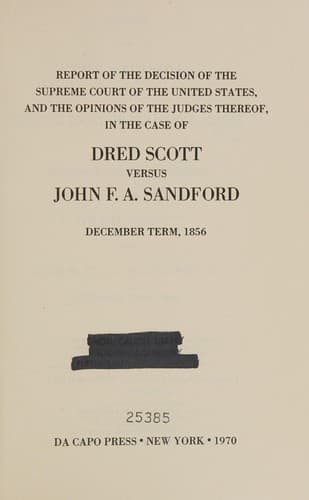
Report of the Decision of the Supreme Court of the United States, and the Opinions of the Judges Thereof, in the Case of Dred Scott versus John F. A. Sandford: December Term, 1856.United States. Supreme Court
History
Report of the Decision of the Supreme Court of the United States, and the Opinions of the Judges Thereof, in the Case of Dred Scott versus John F. A. Sandford: December Term, 1856.
United States. Supreme Court
Scott, Dred, 1809-1858; Slavery -- United States
Some consider the opinion to be loose and inconclusive; others, that
it is _obiter dicta_; and the last sentence is objected to as
recognising absolute power in Congress over Territories. The learned
and eloquent Wirt, who, in the argument of a cause before the court,
had occasion to cite a few sentences from an opinion of the Chief
Justice, observed, "no one can mistake the style, the words so
completely match the thought."
I can see no want of precision in the language of the Chief Justice;
his meaning cannot be mistaken. He states, first, the third section as
giving power to Congress to govern the Territories, and two other
grounds from which the power may also be implied. The objection seems
to be, that the Chief Justice did not say which of the grounds stated
he considered the source of the power. He did not specifically state
this, but he did say, "whichever may be the source whence the power is
derived, the possession of it is unquestioned." No opinion of the
court could have been expressed with a stronger emphasis; the power in
Congress is unquestioned. But those who have undertaken to criticise
the opinion, consider it without authority, because the Chief Justice
did not designate specially the power. This is a singular objection.
If the power be unquestioned, it can be a matter of no importance on
which ground it is exercised.
The opinion clearly was not _obiter dicta_. The turning point in the
case was, whether Congress had power to authorize the Territorial
Legislature of Florida to pass the law under which the Territorial
court was established, whose decree was brought before this court for
revision. The power of Congress, therefore, was the point in issue.
The word "territory," according to Worcester, "means land, country, a
district of country under a temporary Government." The words
"territory or other property," as used, do imply, from the use of the
pronoun other, that territory was used as descriptive of land; but
does it follow that it was not used also as descriptive of a district
of country? In both of these senses it belonged to the United
States--as land, for the purpose of sale; as territory, for the
purpose of government.
Public-domain text, read in full here on John Shaqi.
Reviews
Reviews
No reviews yet
Be the first to share your thoughts on this work.
Elsewhere in the archive
Join the Discussion
Join the discussion
Sign in to leave a comment or review.
Sign InorCreate an account