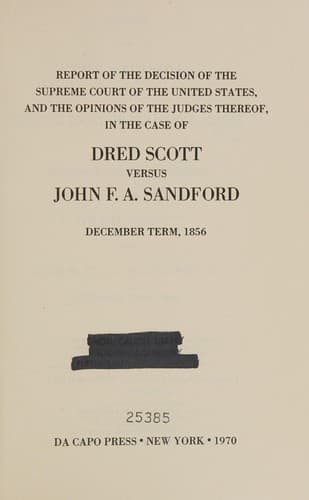
Report of the Decision of the Supreme Court of the United States, and the Opinions of the Judges Thereof, in the Case of Dred Scott versus John F. A. Sandford: December Term, 1856.United States. Supreme Court
History
Report of the Decision of the Supreme Court of the United States, and the Opinions of the Judges Thereof, in the Case of Dred Scott versus John F. A. Sandford: December Term, 1856.
United States. Supreme Court
Scott, Dred, 1809-1858; Slavery -- United States
It is refreshing to turn to the early incidents of our history, and
learn wisdom from the acts of the great men who have gone to their
account. I refer to a report in the House of Representatives, by John
Randolph, of Roanoke, as chairman of a committee, in March,
1803--fifty-four years ago. From the Convention held at Vincennes, in
Indiana, by their President, and from the people of the Territory, a
petition was presented to Congress, praying the suspension of the
provision which prohibited slavery in that Territory. The report
stated "that the rapid population of the State of Ohio sufficiently
evinces, in the opinion of your committee, that the labor of slaves is
not necessary to promote the growth and settlement of colonies in that
region. That this labor, demonstrably the dearest of any, can only be
employed to advantage in the cultivation of products more valuable
than any known to that quarter of the United States; that the
committee deem it highly dangerous and inexpedient to impair a
provision wisely calculated to promote the happiness and prosperity of
the Northwestern country, and to give strength and security to that
extensive frontier. In the salutary operation of this sagacious and
benevolent restraint, it is believed that the inhabitants will, at no
very distant day, find ample remuneration for a temporary privation of
labor and of emigration." (1 vol. State Papers, Public Lands, 160.)
The judicial mind of this country, State and Federal, has agreed on no
subject, within its legitimate action, with equal unanimity, as on the
power of Congress to establish Territorial Governments. No court,
State or Federal, no judge or statesman, is known to have had any
doubts on this question for nearly sixty years after the power was
exercised. Such Governments have been established from the sources of
the Ohio to the Gulf of Mexico, extending to the Lakes on the north
and the Pacific Ocean on the west, and from the lines of Georgia to
Texas.
Great interests have grown up under the Territorial laws over a
country more than five times greater in extent than the original
thirteen States; and these interests, corporate or otherwise, have
been cherished and consolidated by a benign policy, without any one
supposing the law-making power had united with the Judiciary, under
the universal sanction of the whole country, to usurp a jurisdiction
which did not belong to them. Such a discovery at this late date is
more extraordinary than anything which has occurred in the judicial
history of this or any other country. Texas, under a previous
organization, was admitted as a State; but no State can be admitted
into the Union which has not been organized under some form of
government. Without temporary Governments, our public lands could not
have been sold, nor our wildernesses reduced to cultivation, and the
population protected; nor could our flourishing States, West and
South, have been formed.
Public-domain text, read in full here on John Shaqi.
Reviews
Reviews
No reviews yet
Be the first to share your thoughts on this work.
Elsewhere in the archive
Join the Discussion
Join the discussion
Sign in to leave a comment or review.
Sign InorCreate an account