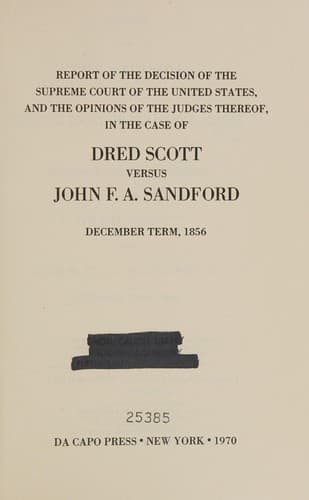
Report of the Decision of the Supreme Court of the United States, and the Opinions of the Judges Thereof, in the Case of Dred Scott versus John F. A. Sandford: December Term, 1856.United States. Supreme Court
History
Report of the Decision of the Supreme Court of the United States, and the Opinions of the Judges Thereof, in the Case of Dred Scott versus John F. A. Sandford: December Term, 1856.
United States. Supreme Court
Scott, Dred, 1809-1858; Slavery -- United States
And when there is a large district of country within the United
States, and not within any State Government, if it be necessary to
establish a temporary Government to carry out a power expressly vested
in Congress--as the disposition of the public lands--may not such
Government be instituted by Congress? How do we read the Constitution?
Is it not a practical instrument?
In such cases, no implication of a power can arise which is inhibited
by the Constitution, or which may be against the theory of its
construction. As my opinion rests on the third section, these remarks
are made as an intimation that the power to establish a temporary
Government may arise, also, on the other two grounds stated in the
opinion of the court in the insurance case, without weakening the
third section.
I would here simply remark, that the Constitution was formed for our
whole country. An expansion or contraction of our territory required
no change in the fundamental law. When we consider the men who laid
the foundation of our Government and carried it into operation, the
men who occupied the bench, who filled the halls of legislation and
the Chief Magistracy, it would seem, if any question could be settled
clear of all doubt, it was the power of Congress to establish
Territorial Governments. Slavery was prohibited in the entire
Northwestern Territory, with the approbation of leading men, South and
North; but this prohibition was not retained when this ordinance was
adopted for the government of Southern Territories, where slavery
existed. In a late republication of a letter of Mr. Madison, dated
November 27, 1819, speaking of this power of Congress to prohibit
slavery in a Territory, he infers there is no such power, from the
fact that it has not been exercised. This is not a very satisfactory
argument against any power, as there are but few, if any, subjects on
which the constitutional powers of Congress are exhausted. It is true,
as Mr. Madison states, that Congress, in the act to establish a
Government in the Mississippi Territory, prohibited the importation of
slaves into it from foreign parts; but it is equally true, that in the
act erecting Louisiana into two Territories, Congress declared, "it
shall not be lawful for any person to bring into Orleans Territory,
from any port or place within the limits of the United States, any
slave which shall have been imported since 1798, or which may
hereafter be imported, except by a citizen of the United States who
settles in the Territory, under the penalty of the freedom of such
slave." The inference of Mr. Madison, therefore, against the power of
Congress, is of no force, as it was founded on a fact supposed, which
did not exist.
Public-domain text, read in full here on John Shaqi.
Reviews
Reviews
No reviews yet
Be the first to share your thoughts on this work.
Elsewhere in the archive
Join the Discussion
Join the discussion
Sign in to leave a comment or review.
Sign InorCreate an account