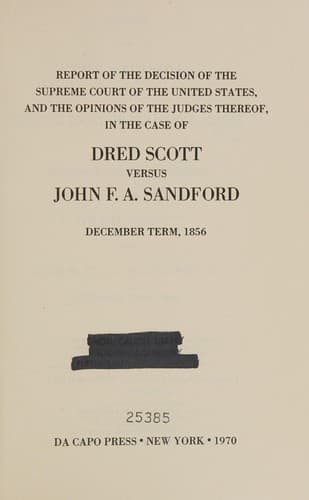
Report of the Decision of the Supreme Court of the United States, and the Opinions of the Judges Thereof, in the Case of Dred Scott versus John F. A. Sandford: December Term, 1856.United States. Supreme Court
History
Report of the Decision of the Supreme Court of the United States, and the Opinions of the Judges Thereof, in the Case of Dred Scott versus John F. A. Sandford: December Term, 1856.
United States. Supreme Court
Scott, Dred, 1809-1858; Slavery -- United States
A slave is brought to England from one of its islands, where slavery
was introduced and maintained by the mother country. Although there is
no law prohibiting slavery in England, yet there is no law authorizing
it; and, for near a century, its courts have declared that the slave
there is free from the coercion of the master. Lords Mansfield and
Stowell agree upon this point, and there is no dissenting authority.
There is no other description of property which was not protected in
England, brought from one of its slave islands. Does not this show
that property in a human being does not arise from nature or from the
common law, but, in the language of this court, "it is a mere
municipal regulation, founded upon and limited to the range of the
territorial laws?" This decision is not a mere argument, but it is the
end of the law, in regard to the extent of slavery. Until it shall be
overturned, it is not a point for argument; it is obligatory on myself
and my brethren, and on all judicial tribunals over which this court
exercises an appellate power.
It is said the Territories are common property of the States, and that
every man has a right to go there with his property. This is not
controverted. But the court say a slave is not property beyond the
operation of the local law which makes him such. Never was a truth
more authoritatively and justly uttered by man. Suppose a master of a
slave in a British island owned a million of property in England;
would that authorize him to take his slaves with him to England? The
Constitution, in express terms, recognises the _status_ of slavery as
founded on the municipal law: "No person held to service or labor in
one State, _under the laws thereof_, escaping into another, shall,"
&c. Now, unless the fugitive escape on a place where, by the municipal
law, he is held to labor, this provision affords no remedy to the
master. What can be more conclusive than this? Suppose a slave escape
from a Territory where slavery is not authorized by law, can he be
reclaimed?
In this case, a majority of the court have said that a slave may be
taken by his master into a Territory of the United States, the same as
a horse, or any other kind of property. It is true, this was said by
the court, as also many other things, which are of no authority.
Nothing that has been said by them, which has not a direct bearing on
the jurisdiction of the court, against which they decided, can be
considered as authority. I shall certainly not regard it as such. The
question of jurisdiction, being before the court, was decided by them
authoritatively, but nothing beyond that question. A slave is not a
mere chattel. He bears the impress of his Maker, and is amenable to
the laws of God and man; and he is destined to an endless existence.
Under this head I shall chiefly rely on the decisions of the Supreme
Courts of the Southern States, and especially of the State of
Missouri.
Public-domain text, read in full here on John Shaqi.
Reviews
Reviews
No reviews yet
Be the first to share your thoughts on this work.
Elsewhere in the archive
Join the Discussion
Join the discussion
Sign in to leave a comment or review.
Sign InorCreate an account